




 ?
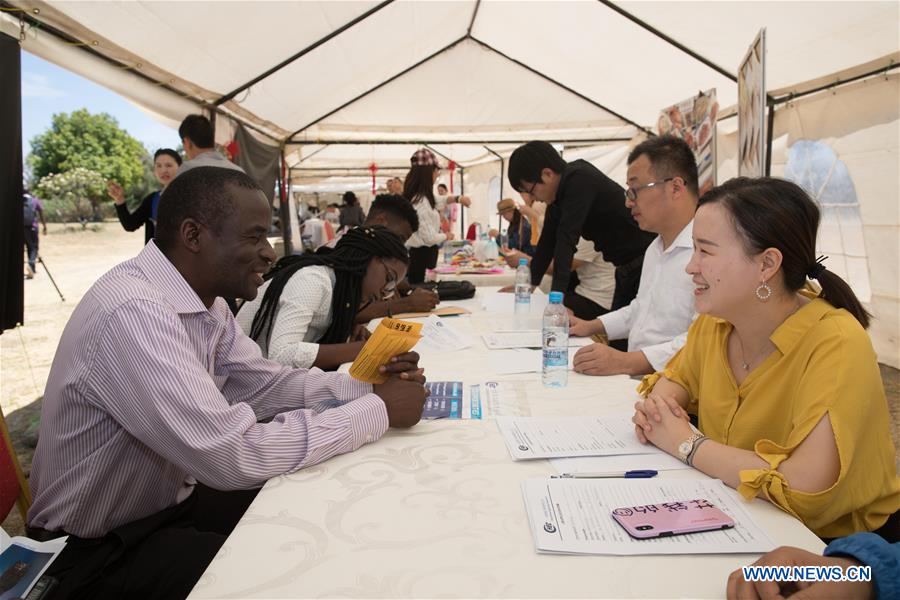
?Representatives of Chinese enterprises talk with job seekers during a jobs expo held by the Confucius Institute at the University of Zambia in Lusaka, Zambia, Oct. 26, 2018. (Xinhua/Peng Lijun)
by Xinhua writer Qu Junya
BEIJING, Nov. 27 (Xinhua) -- A new art space in Nuremberg is bringing China closer to the southern German city.
The opening show of works by Chinese and German artists in late October highlighted the venue's role in being a cultural bridge. The space will offer philosophic and artistic perspectives on cultural encounters, said Guenther Beckstein, former state premier of Bavaria and senior advisor to the Confucius Institute of Friedrich Alexander University Erlangen-Nuremberg, which initiated the art space.
The space represents a new attempt in the Institute's agenda to diversify its educational and cultural offerings, with Chinese language teaching at the core.
CULTURAL BRIDGE
China's Confucius Institute is a non-profit, international public educational organization, similar to Britain's British Council, France's Alliance Francaise, Germany's Goethe Institute or Spain's Cervantes Institute.
Built in cooperation with a local educational institution and run by a bilateral committee and dual-presidency structure, more than 530 Confucius Institutes and 1,110 Confucius Classrooms have landed in 149 countries and regions over the 14 years since its debut in Seoul.
"The U.S. and China will never really understand each other unless we study their language and culture and share experiences that build a foundation for dialogue," said Susan Jain, executive director of the Confucius Institute of University of California, Los Angeles (UCLA), which was founded in 2007.
"We've been criticized by some far-right Senators of being too close to China. That's ironic because our top priority has been to help under-privileged kids here in the U.S. get ahead," said Jain.
"Our cultures, our economies, our destinies are irrevocably intertwined. Young people get that, in spite all the rhetoric and negativity they hear from Washington," said theater director Peter Sellers, now UCLA professor in world arts and culture. "The Institute opens doors."
In Germany, the 17th Confucius Institute was launched in 2016 in the northeastern town Stralsund. Chancellor Angela Merkel said at the inauguration, "Germany has a rich culture and traditions. We also know that China has a long history of five thousand years of civilization. Confucius Institute can contribute to promoting communication and understanding between the two peoples."
Similar to the Confucius Institute in London, the one at Merkel's "political home" features traditional Chinese medicine programs. There's one in Kenya focused on textiles, in Ethiopia on vocational education, and another at the Royal Danish Academy of Music on Chinese music. Confucius Institutes around the world cater to local needs.
Academic exchange is becoming another part of the Institute's identity. In late September, the school at Paris Diderot University hosted a seminar on social administration. Thanks to the Confucius Institute at the University of Geneva, visiting Chinese archaeologists learned from the techniques of their Swiss counterparts during a 10-day workshop last summer.
JOB OPPORTUNITIES
Jain feels the Confucius Institute's language programs are key to giving American kids a competitive future. "When American kids learn languages like Mandarin and understand more about foreign cultures, it opens up all kinds of well-paid job opportunities for them and makes them better equipped to compete with applicants from other countries."
Speaking Chinese fluently during a Confucius Institute event in late September, first year Stanford University student Charlie Hoffs said her romance with Chinese started from the love of Chinese characters.
"Then I increasingly realized the language's importance for the economy and tourism," she said. "Chinese is a vital skill."
For Lytone Chibona, a Confucius Institute student in University of Zambia, learning Chinese is simply practical. "Very few of them take up practical skills such as learning the Chinese language ... which they can use while looking for a job. That skill can later turn out to be your main job in the long run," said the 22-year-old.
In October, local branches from 14 Chinese enterprises visited a job fair held by the University of Zambia's Confucius Institute. "Our business is growing with the participation of hundreds of Zambians, so we come here to recruit more skilled young workers," said Linda Yan, a human resources manager with the Chinese aviation company AVIC International.
Expanding cooperation in countries under the China-proposed Belt and Road Initiative (BRI) leads to increased Chinese investments and local jobs. Learning Chinese has thus become a trend in Belarus, for example.
High school student Anastasiya Solonets said she has been studying Chinese for four years and will continue part-time at the Confucian Institute when in college. "I hope to get a good job in the (China-Belarus) industrial park."
Likewise in Tajikistan, the craze to learn Chinese in recent years has prompted some 3,000 people a year to pursue further study in China, making China the second largest host country of its overseas students.
CULTURAL DIVERSITY
Speaking of the UCLA Confucius Institute, Shabnam Fasa, artistic director of the Santa Monica Youth Orchestra, told Xinhua: "The Institute is a powerful force for cultural diversity. They are looking to teach the world what true collaboration and multi-cultural discourse looks like in a creative, impactful way."
Globally, more than 9 million students have attended Confucius Institutes and Classrooms. Calligraphy, ink painting, or kung fu complement the language program. The Institute also plays a role in promoting traditional Chinese festival celebrations.
A dragon boat sailing event in June took the northern Portuguese city of Aveiro by storm that city official Catarina Barreto called for more such events in the future, saying it combined the traditional cultures of Portugal and China.
In the Italian town of Castel Maggiore in September, a Chinese bun stuffed with Bolognese mince brought the Mid-Autumn Festival celebrations there to a climax.
"What I like most about Chinese culture is that it's rich, it's deep, it exposes you to a lot of things," said Charles Wanika, a Kenyan student.
(Xinhua reporters Julia Pierrepont III, Peng Lijun, Yu Xiaohua, Sun Mei, Hu Jing, Wei Zhongjie, Li Jia and Zhang Yuan contributed to the story.)
(Video editor: Zhu Cong)
