Xinhua Headlines: From Xinjiang's desert to economic hubs: a power expressway that lights up both ends

*Altogether, three such UHV DC transmission lines have reshaped the region's outbound power transmission -- accounting for over 90 percent of the region's total -- carving out a power expressway atop existing corridors that connect wind- and solar-rich Xinjiang with power-hungry coastal cities and economic hubs across the country.
*Since Xinjiang began delivering power to other regions in 2010, it has transmitted over 1 trillion kWh of electricity to 22 provincial regions across China -- enough to power 1.4 billion people's lives for 306 days. One-third of all kilowatt-hours of electricity comes from renewables, delivering climate benefits equivalent to planting approximately 13 billion trees.
*Beyond energizing distant cities, the power "expressway" also spurred local dynamism by attracting new energy enterprises and creating jobs for farmers and herders across Xinjiang.
URUMQI, Jan. 13 (Xinhua) -- Across Xinjiang's wind-lashed Gobi Desert and sun-scorched basins, the rotation of the wind turbine blades and the pulse of solar energy feed power into the grid that, in a flash, lights up homes thousands of kilometers away.
In just 0.007 seconds, electricity generated in Hami, in northwest China's Xinjiang Uygur Autonomous Region, races across mountains and rivers to the megacity of Chongqing, located 2,260 kilometers away, powering the automotive and electronic assembly lines there and, more critically, fueling air conditioners in the city's ruthlessly sultry summer.
The blitz-like transmission was made possible by ultra-high-voltage (UHV) technology, a technology well-suited for long-distance transmission due to its minimal energy loss. It refers to power transmission technology with exceptionally high voltage levels, typically defined as alternating current (AC) projects at 1000 kV and above and direct current (DC) projects at ±800 kV and above.
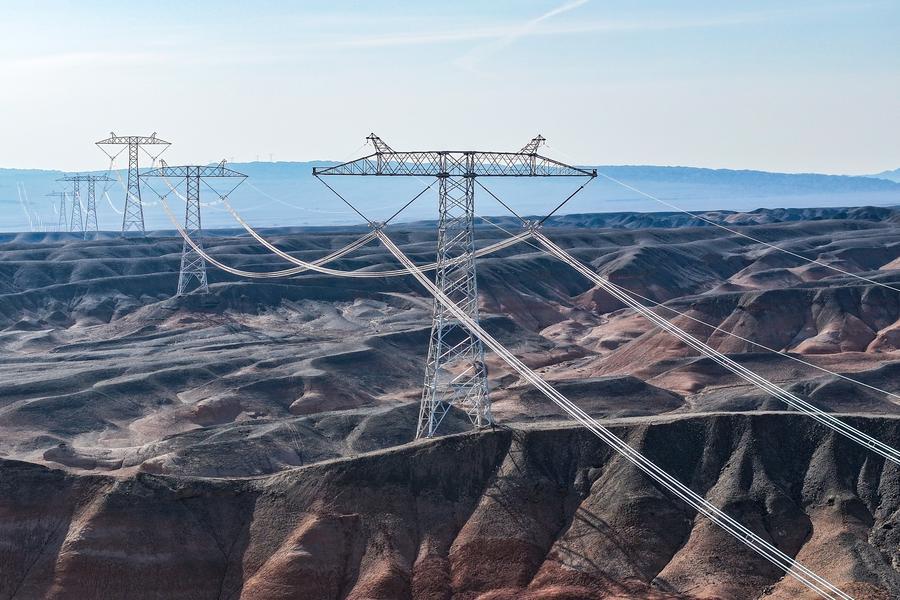
Altogether, three such UHV DC transmission lines have reshaped the region's outbound power transmission -- accounting for over 90 percent of the region's total -- carving out a power expressway atop existing corridors that connect wind- and solar-rich Xinjiang with power-hungry coastal cities and economic hubs across the country.
They are part of a nationwide network of 42 UHV lines, built to bridge a great divide: while China's energy deposits, coal, wind, solar and hydrogen, are concentrated in the west, its largest thirst for power lies in the central and eastern provinces.
Power blackouts were not a distant memory. While rolling blackouts were once a crude response to shortages, UHV has made large-scale, long-distance transmission an everyday reality today.
Xinjiang's geography -- its vast north-south span and broad landmass -- provides abundant wind and solar resources, noted Ren Juan, a researcher at a research institute affiliated with State Grid Xinjiang Electric Power Co., Ltd. "The region has become a critical transmission hub and a key player in building China's energy base."
The numbers tell a stunning story. Since Xinjiang began delivering power to other regions in 2010, it has transmitted over 1 trillion kWh of electricity to 22 provincial regions across China -- enough to power 1.4 billion people's lives for 306 days. One-third of all kilowatt-hours of electricity comes from renewables, delivering climate benefits equivalent to planting approximately 13 billion trees.
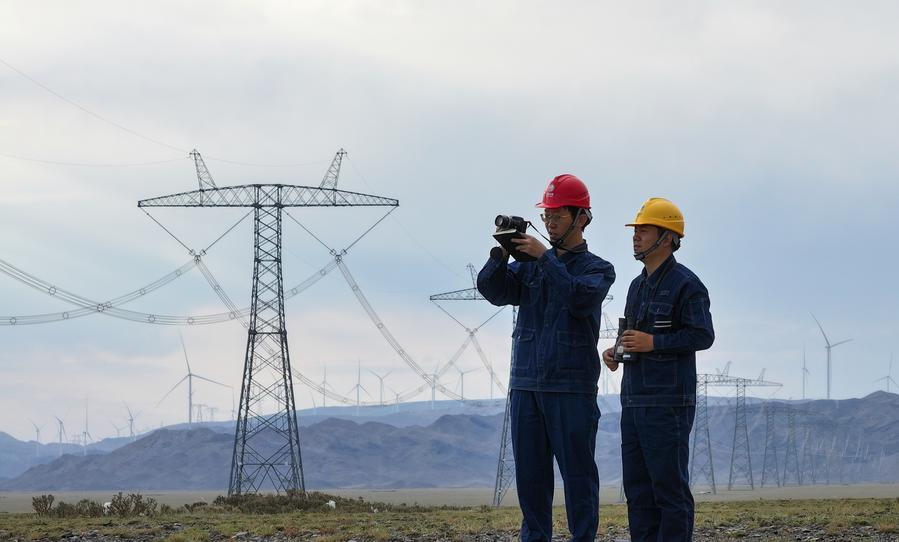
Beyond energizing distant cities, the power "expressway" also spurred local dynamism by attracting new energy enterprises and creating jobs for farmers and herders across Xinjiang.
POWERING DISTANT CITIES
In January 2014, the Hami South-Zhengzhou UHV DC line commenced operation, marking the launch of large-scale electricity transmission from Xinjiang to other regions. In September 2019, the Changji-Guquan UHV DC project was launched, linking China's far-west Xinjiang with the eastern powerhouse, a distance comparable to that from Idaho to New York. In June 2025, the Hami-Chongqing line was mounted across China's northwest and southwest.
In the receiving end, approximately 20 percent of the eastern province of Anhui's electricity now streams from Xinjiang, around 10 percent of central China's Henan Province's peak demand is met by Xinjiang-sourced power, and Chongqing also benefits from a stable supply of clean energy from Xinjiang.
Among them, Chongqing, a southwest megacity with a population of more than 30 million, has consumed over 10 billion kWh of electricity from Xinjiang since the Hami-Chongqing line became operational on June 10, 2025.
The vital electricity supplement sourced from Xinjiang has alleviated Chongqing's energy constraints, helping the city cope with a surging summer demand in 2025, according to a statement from the State Grid Chongqing Electric Power Company.
In another prominent case, during the 19th Asian Games in Hangzhou, located in east China's Zhejiang Province, the lights that gleamed over stadiums and arenas were powered, in part, by electricity that had traveled from Changji Hui Autonomous Prefecture in Xinjiang, through the Changji-Guquan line.
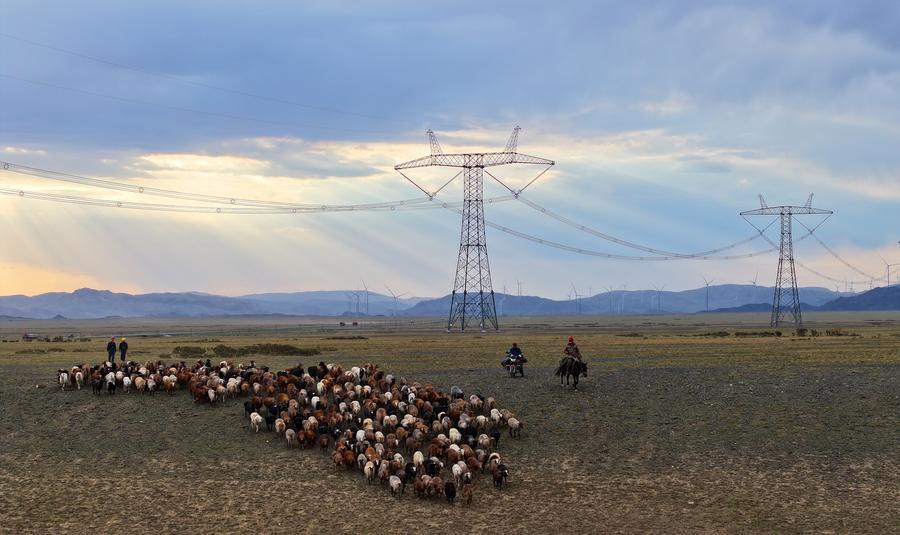
Across the country, a total of 42 UHV projects comprising 22 AC and 20 DC lines achieved an inter-regional and inter-provincial power transmission capacity of 370 million kW.
The benefits are felt far beyond power grids. According to State Grid Xinjiang Electric Power Co., Ltd, since the first transmission corridor was launched in 2010, Xinjiang has delivered green electricity of over 291.5 billion kWh, which amounted to saving approximately 88.18 million tonnes of standard coal, reducing emissions of 238 million tonnes of carbon dioxide, apart from other pollutants, contributing to China's dual carbon goals -- peaking carbon emissions by 2030 and achieving carbon neutrality by 2060.
INVIGORATING LOCAL ECONOMY
Once a land where herders followed the seasons and young people left for opportunities elsewhere, the Mori Kazakh Autonomous County of Changji now hosts an installed new energy capacity of over 20 million kW, driven by a new energy boom sparked by the Changji-Guquan UHV project.
Now a pacesetter in Xinjiang's new energy industry, Mori has attracted industry giants like Dongfang Electric to build a presence in the desolate Gobi desert, drawing a new generation back home and rewriting local destinies.
Bihazi, 31, a member of the Kazakh ethnic group, is one of them. He now works at the Mori new-energy high-end equipment manufacturing base of Dongfang Electric, where he is responsible for layup, resin infusion, assembly, parts fitting, and debugging of wind turbine blades and main units.
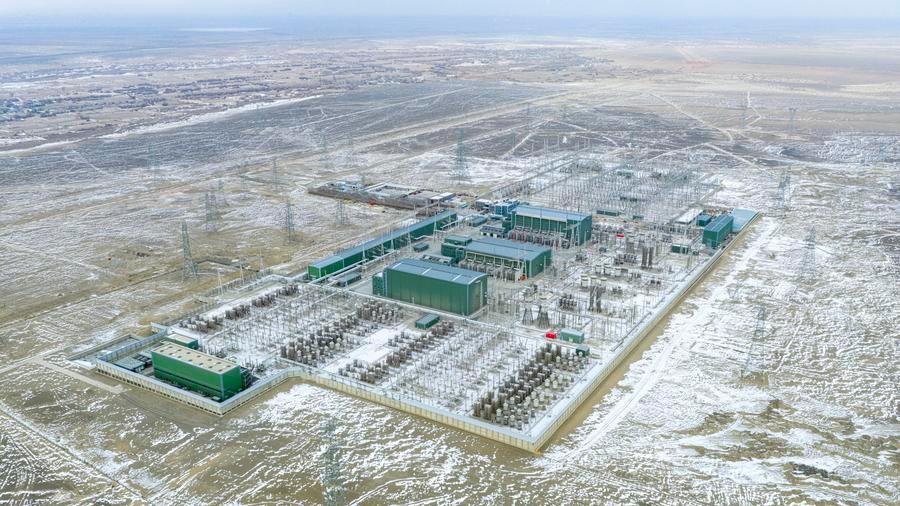
Bihazi started with no knowledge of wind equipment manufacturing. Through technical training and hands-on guidance that covered everything from basic mechanical principles to operational expertise, he gradually adapted to his role and ultimately excelled.
Today, he earns a stable monthly income of over 6,000 yuan (about 855.9 U.S. dollars) and has purchased an apartment and a car.
"Now I can provide for my family while staying close to them -- a good life I never dared to dream of before. My life has improved so much that I've even referred friends and relatives to work here!" he added.
Overall, the three UHV projects, with a direct investment of nearly 100 billion yuan, have driven investments of over 300 billion yuan in upstream and downstream supply chains, creating more than 58,000 jobs, according to an estimation by the research institute affiliated with State Grid Xinjiang Electric Power Co., Ltd.
From Xinjiang's Gobi desert to gleaming streets in distant cities, Xinjiang's energy is now a pulse felt across the nation -- powering growth, cleaning skies, and lighting up lives -- both far away and right at home.
(Video reporters: Bai Zhiqiang, Jia Zhao, Tian Ying, Du Gang and Zhou Shengbin; video editors: Hong Yan, Roger Lott and Hui Peipei) ■










Comments