Xinhua Headlines: China's Spring Festival travel rush kicks off with more NEVs, holidaymakers

* On Monday, the annual Spring Festival travel rush began ahead of China's most important holiday.
* This year's travel season is expected to see more new energy vehicles and more family travel.
* The nine-day holiday is expected to give consumption a boost.
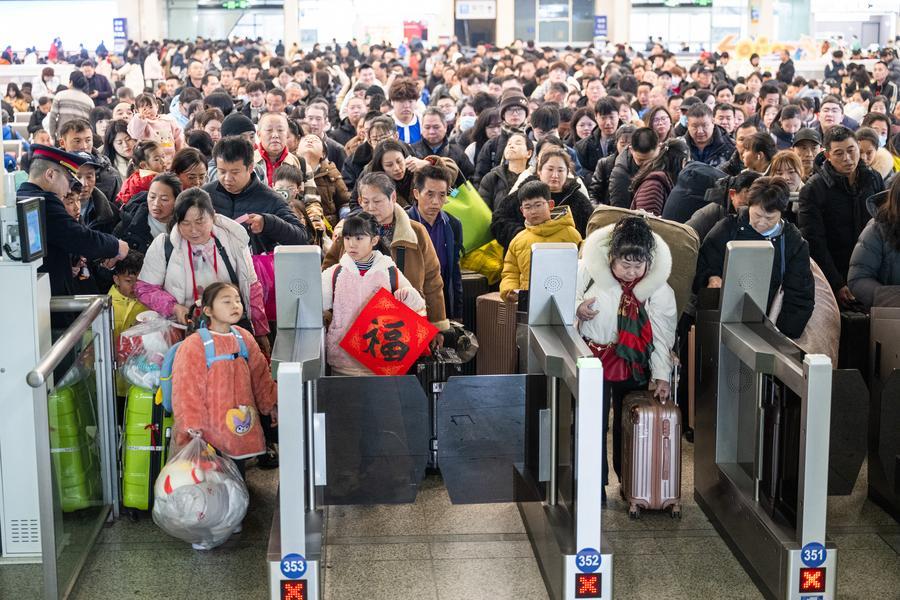
BEIJING, Feb. 2 (Xinhua) -- Early Monday, highways were already busy, while train stations and airports across China filled with travelers as the Spring Festival travel rush began ahead of the country's most important holiday.
The Spring Festival, also known as Chinese New Year, falls on Feb. 17 this year. The official holiday lasts nine days, with many factory workers taking more time off and students on winter vacation.
The annual homeward journey -- the world's largest human migration -- places an immense strain on China's transportation network. Authorities expect a record 9.5 billion inter-regional trips during the 40-day travel rush, known as chunyun.
This year's travel season is expected to see more new energy vehicles (NEVs) and more family travel, as travelers head not only to their hometowns but also to cities where family members live or to holiday destinations chosen simply to spend time together.
In the quiet streets of Wuhan, capital of central China's Hubei Province, Zhang Ming slid into the driver's seat of his NEV, activated the navigation system with a voice command and set off on an 800-km journey back to his hometown in Chongqing Municipality, the trunk packed with bags of vegetables, meatballs and lotus roots.
"For our first Spring Festival after getting married, we took annual leave so we could head home early," said Zhang, 35, who works in the internet sector. "We wanted to get a head start on the New Year feeling and bring a taste of Hubei home for our family."
ON THE MOVE
More families like Zhang's are choosing to drive home, with a growing share of those journeys made in NEVs. Transport officials estimate that around 80 percent of trips during the chunyun period will take place by road.
Zhang's car has a range of more than 600 km on a full charge. Accounting for winter temperatures, he planned three charging stops, pulling into expressway service areas whenever the battery level dropped to around 30 percent.
"Now the technology is better, charging is easier, and driver-assist systems make long trips less tiring," he said.
By the end of 2025, China's NEV fleet had reached 43.97 million, including 12.93 million newly registered vehicles during the year. More than 71,500 EV chargers had been installed at expressway service areas nationwide, easing concerns about long-distance travel during peak holiday periods.
Railway and civil aviation authorities have also increased travel capacities, with passenger volumes projected to reach 540 million by rail and 95 million by air, both expected to set records for overall scale and peak daily traffic.

The travel experience itself has changed with the spread of new technologies.
Once defined by migrant workers carrying bulging woven bags through crowded train carriages, chunyun today features passengers scrolling on phones, ordering meals with a tap and streaming videos aboard high-speed trains that traverse China's vast network, the largest in the world. In stations, robots patrol concourses, while drones assist with inspections along rail lines.
China is expected to be hit by four cold waves in February, potentially affecting the peak of the Spring Festival travel rush.
Wang Yawei, a spokesperson for the China Meteorological Administration, said the agency is using satellites, weather radar, digital forecasting systems and AI to improve real-time monitoring and forecasts of extreme winter weather.
Airports are also deploying new technology to cope with winter conditions. At Wuhan Tianhe International Airport, which expects about 27,000 flights during the chunyun period, up 2.5 percent from a year earlier, a smart de-icing management system has helped keep flights on schedule.
On Jan. 19, when snow hit the city, crews cleared nearly 4 million square meters of runways and aprons in less than five hours, cutting the time needed previously by about half, said Zhao Wei, head of the airport's de-icing operations team.
WHERE FAMILIES GO, HOME FOLLOWS
China's Spring Festival travel rush began in the 1980s, as millions of rural workers moved to cities for jobs and returned home once a year for family reunions. That pattern is now shifting, with more parents traveling to big cities to spend the holiday with children who live and work there, a trend often called the "reverse Spring Festival trip."
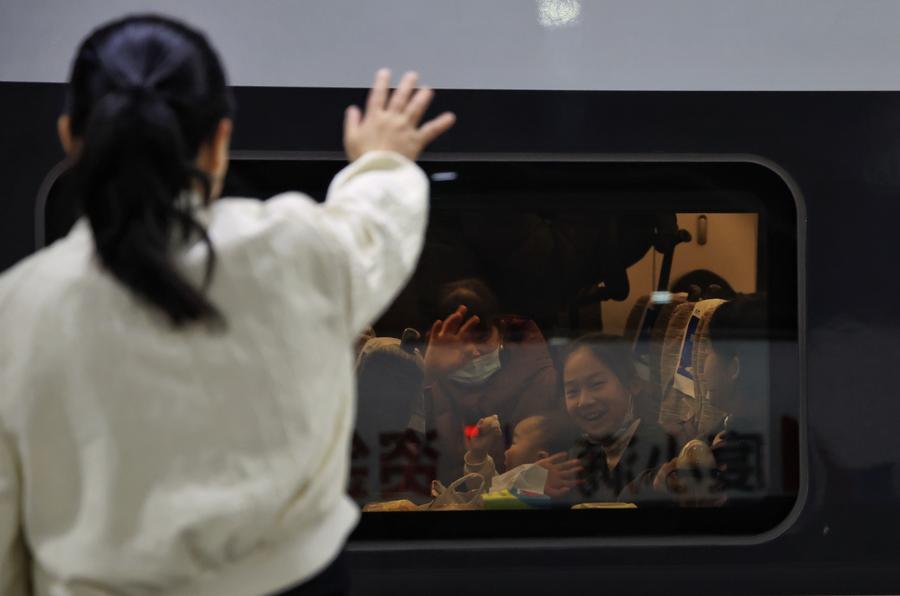
Dong Zhiyong, 61, and his wife left their home in Yuncheng, north China's Shanxi Province, to celebrate the holiday with their daughter in Beijing. When Xinhua reporters met them at a railway station, they were carrying two boxes of apples, a local specialty, as gifts.
"My daughter and her husband have short holidays, and my grandson is busy with his studies," Dong said. "But we are retired, so we have time for a family reunion." The couple plans to visit tourist attractions in Beijing and may also take a short trip to the neighboring city of Tianjin.
Data from travel services platform Qunar show that air ticket bookings by passengers aged 60 and above rose more than 35 percent year on year during the Spring Festival holiday, with major cities such as Beijing, Shanghai, Guangzhou, Chengdu and Shenzhen among their top destinations. The number of travelers over 60 buying their first-ever air tickets on the platform rose 22 percent.
Home is no longer the only destination during chunyun. He Xiangzhi and three friends plan to take their families from Tianjin to Datong, a city in Shanxi known for its cultural heritage.
"Spending the New Year somewhere I've never been brings a sense of novelty," He said. "We want to see different landscapes and learn about local customs."
Li Yanan, owner of a traditional courtyard hotel in Datong, said the rooms are fully booked for the holiday. "Travel, family reunions and celebrating the festival can all come together," he said.
Deng Aimin, a culture and tourism expert at Jiangxi University of Finance and Economics, said the Spring Festival travel rush has evolved beyond simply moving people.
"Family visits are increasingly combined with tourism, as short-distance trips, county-level travel and winter tourism gain popularity, driving spending on dining, accommodation, holiday goods and cultural products," Deng said.
The shift is giving consumption a boost. During the 2025 Spring Festival holiday, China saw a record 501 million domestic tourist trips, up 5.9 percent from a year earlier, while tourist spending topped 677 billion yuan (about 97.14 billion U.S. dollars), a 7 percent increase.
To capture demand during this year's Spring Festival holiday, authorities have launched a month-long cultural and tourism campaign featuring around 30,000 activities nationwide, along with more than 360 million yuan in consumption vouchers and subsidies.
"Chunyun has become a window into population flows, industrial patterns, how city clusters function and the effectiveness of public governance," Deng said, adding that it also reflects the enduring value of family reunions and Spring Festival traditions, as well as the growing vitality of the economy. ■
(Reporting by Cheng Lu, Bai Xu, Yue Wenwan, Wang Xuetao, Xiong Xianghe, Xu Xiong, Tian Zhongquan, Yu Pei and Zhao Yunzhuo; Video reporters: Pan Zhiwei, Xu Wei, Wang Xuetao, Xu Xinyuan and Wang Ruiping; Video editors: Zhang Yucheng, Liu Xiaorui and Hong Yan.)











Comments