Economic Watch: How the Spring Festival channels mobility, time and consumption

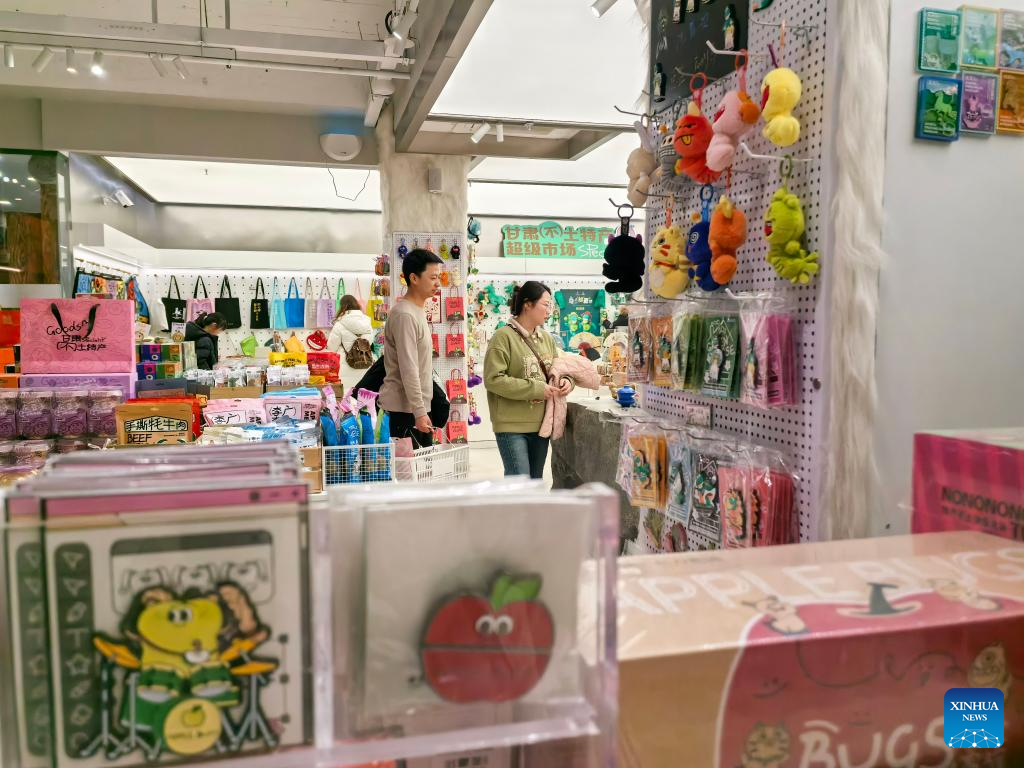
Tourists visit a gift shop of Gansu Provincial Museum in Lanzhou, northwest China's Gansu Province, Jan. 26, 2026. (Xinhua/He Wen)
LANZHOU, Feb. 13 (Xinhua) -- China's Spring Festival has long been described as the world's largest annual migration. This year, China State Railway Group Co., Ltd. expects 540 million passenger trips during the 40-day travel rush. Traditionally, the emphasis has been on logistics: moving hundreds of millions of people across a vast territory within a narrow time window.
Increasingly, however, the travel rush functions as more than a transport challenge. It has become a high-density platform for cultural distribution, where mobility, leisure time and seasonal spending converge.
Early this week, a selected high-speed train service running from Lanzhou in northwest China's Gansu Province to Guangzhou in the south was redesigned as "mobile museums": nine national first-class museums in Gansu curated exhibitions for train carriages, featuring visual installations inspired by Han-dynasty bamboo slips, Dunhuang murals, millennia-old Majiayao painted pottery, and the iconic Bronze Galloping Horse.
Museum educators conducted timed interpretive sessions on board and arranged outreach events at major stops, and passengers could participate in basic hands-on activities linked to the artifacts.
The initiative is modest in scale, yet significant in what it signals. As of 2025, China's total operating railway mileage reached 165,000 kilometers, including more than 50,000 kilometers of high-speed lines, the largest such rail network in the world. When museums place exhibitions on trains, they are attaching cultural content to one of the country's most extensive distribution systems. Infrastructure thus becomes a transmission channel.
The timing enhances visibility. Spring Festival compresses travel, attention, and family reunion into a nationally concentrated time window. As Professor Mao Jinhuang of the School of Economics at Lanzhou University noted, the Spring Festival travel rush has long extended beyond transportation, aggregating cultural traditions, emotional attachments, and social change into a single social event.
A similar concentration of time and attention appears in how leisure hours are organized during the holiday.
In Gansu's Baiyin City, a local bookstore has expanded its operations to include a 24-hour reading space. Covering roughly 850 square meters and housing more than 20,000 books, it hosted 76 events in 2025, including reading sessions and art salons. Since 2020, the city's public library system has operated 24-hour reading rooms and themed spaces such as film libraries, while expanding smart borrowing services and AI-assisted reading experiences. In 2025 alone, Baiyin held more than 610 reading promotion activities.
National survey data released by the Chinese Academy of Press and Publication show that both print and e-book reading volumes among adults increased in 2024. According to Zhu Qiantao, a professor at Lanzhou University of Finance and Economics, bookstores, already regarded as urban cultural landmarks, are expanding their functions in response to evolving cultural consumption patterns.
What matters less is the individual reader and more the concentration of leisure time during the Spring Festival, which historically centered on domestic rituals and reunion meals. The expansion of round-the-clock reading spaces during the holiday suggests that leisure hours are increasingly absorbed by structured cultural consumption. Time off work, combined with heightened cultural awareness, creates a predictable demand window.
Commerce provides the mechanism through which cultural capital is converted into economic value. Ahead of the Year of the Horse, the Gansu Provincial Museum released creative merchandise inspired by the Bronze Galloping Horse. Plush toys, decorative figurines and themed ornaments reinterpret the artifact's symbolism in contemporary formats. Within a week of launch in late January, the museum's online flagship store recorded nearly 1,000 orders for related products.
Elsewhere, artisans have produced embroidered horse motifs, seal engravings, and cloisonné ornaments tied to the same theme. The sales figures, ranging from several hundred to around a thousand units during the post-launch period, as reported by individual studios, demonstrate the extent to which intangible heritage and museum artifacts have been translated into festival-timed consumer goods.
Liu Xiaocheng, dean of the School of Journalism and Communication at Lanzhou University, noted that the horse carries long-standing associations with vigor and progress in Chinese culture. "As sales of cultural and creative products continue to grow, horse-themed designs respond to the public's cultural and emotional needs," Liu said. "They help stimulate demand in the cultural consumption market."
The Spring Festival increasingly functions as a dense distribution system. Mobility concentrates population flows, public holidays compress leisure time, and festive spending channels demands. Infrastructure, digital platforms, and urban cultural venues intersect within the same period.
None of these replaces the holiday's core function as a family reunion. Rather, they layer additional economic and cultural functions onto it. High-speed trains distribute images and narratives alongside passengers. Bookstores extend hours to capture concentrated attention. Museums align product launches with the lunar calendar.
In a system defined by large-scale mobility and coordinated infrastructure, culture adapts through integration rather than disruption. The Spring Festival remains a ritual return home. Increasingly, it is also a seasonal machine that channels infrastructure, heritage and consumption into a coordinated flow.
The migration remains vast. So does the cultural traffic that travels with it. ■
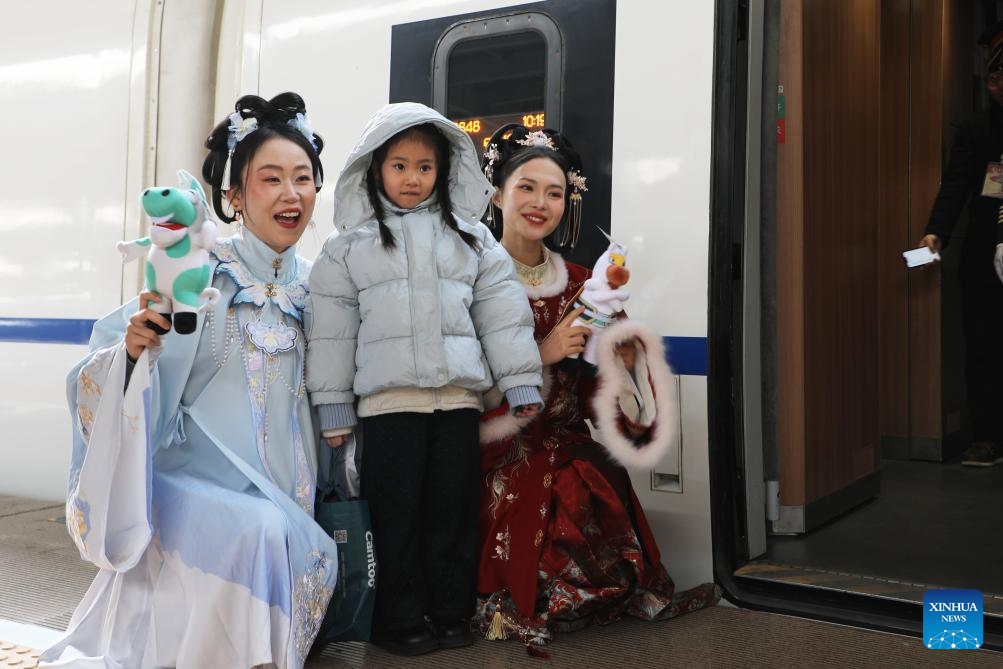
A tourist poses for photos with two costumed staff members of Wuwei Museum at Lanzhou West Railway Station in Lanzhou, northwest China's Gansu Province, Feb. 9, 2026. (Xinhua/Zhang Zhimin)


