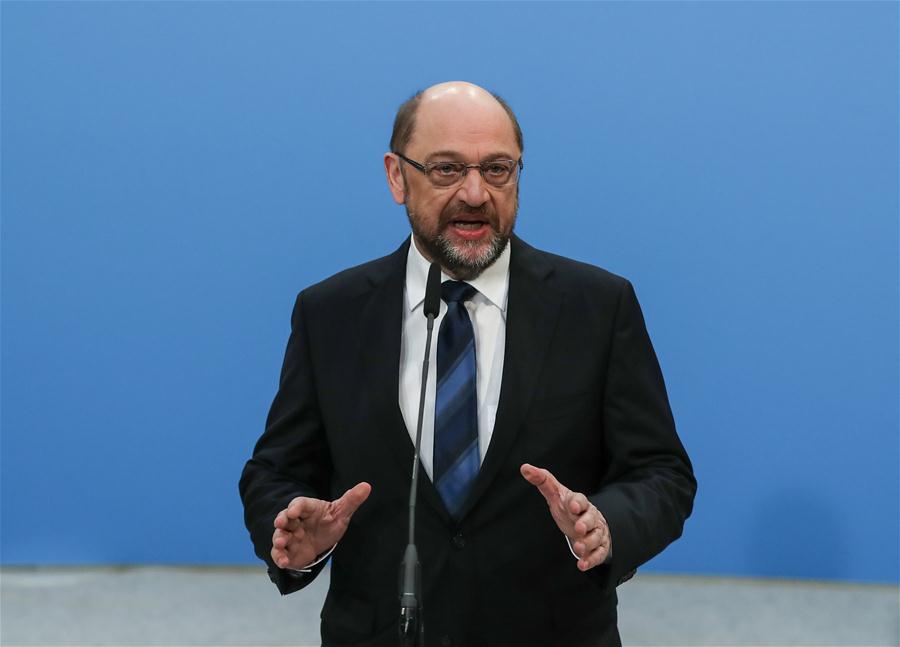
Leader of German Social Democratic Party (SPD) Martin Schulz delivers a speech before the start of coalition talks at the Christian Democratic Union (CDU) party headquarters in Berlin, capital of Germany, on Jan. 26, 2018. (Xinhua/Shan Yuqi)
BERLIN, Feb. 6 (Xinhua) -- The last round of "grand coalition" negotiations in Germany has dragged on into the second of two planned "reserve days" on Tuesday.
After failing to conclude marathon talks between the Christian Democratic Union (CDU), Christian Social Union (CSU) and German Social Democrats (SPD) by Monday night, SPD leader Martin Schulz told press in Berlin that Tuesday would now be "the day of decision."
Similarly, CSU regional leader and senior negotiator Alexander Dobrindt predicted that "the hour of truth is nearing."
Dobrindt added that all parties would have to "leave their trenches" in the final leg of negotiations to ensure their success.
Speaking before the resumption of talks, German Chancellor and CDU leader Angela Merkel had urged the negotiating parties to show a willingness for compromise.
"Every one of us will still have to make painful concessions. I am willing to do so, as long as the advantages outweigh the disadvantages at the end", Merkel said.
The veteran stateswoman said the recent U.S. stock market crash showed that Germans lived in uncertain times and stressed the consequential need to form a "stable government" which was capable of guaranteeing "security and prosperity" in the future.
Merkel identified health care, the labor market and "international reliability" as three areas of dispute between the CDU, CSU and SPD which were still unresolved.
The third term refers to German public expenditure for its armed forces and development aid. The CDU and CSU want to raise defense spending from 1.2 percent of gross domestic product (GDP) to 2 percent of GDP in line with the official NATO goal. By contrast the SPD views increasing developmental aid funds from 0.52 percent in 2016 to 0.7 percent as a more urgent priority.
Whereas a compromise made be relatively-easily obtainable in this area by raising contributions to both budgets, health and labor market policy are seen as constituting more formidable hurdles to the formation of a new government.
Amongst others, the SPD has publicly committed to reducing inequalities between the private and public health care sectors, as well as limiting the amount of fixed-term employment contracts unless their duration is related to the nature of the work. The left-wing party has encountered firm resistance from the conservative CDU and CSU on both of these points.
Unlike the leadership of the CDU and CSU, SPD leader Schulz has promised the more than 400,000 strong membership of his party a final say on whether or not to ultimately join what would already be Merkel's fourth governing cabinet following the drafting of a coalition agreement.
Senior SPD figures have expressed hopes that a vote in favor of another "grand coalition" could be secured from members if the CDU and CSU offered sufficient policy concessions in the last round of talks.
On Monday, Schulz praised an agreement between the parties on Europe as marking a "new start" for the continent and an "end to the austerity dogma."
Schulz showcased confidence on Tuesday that a viable deal would be struck in the course of the day.
"I have good reasons to assume that we will reach the end today with a good result for our country", the former president of the European Parliament told press. Schulz added that the decision to include two "reserve" or "buffer" days in the negotiating schedule had proven wise in hindsight, given the expiration of an earlier deadline on Sunday.
Senior CDU politician and governor of Hesse Volker Bouffier also said that the failure of talks at this late stage was unlikely. However, Bouffier said that he "did not rule anything out" and described the final stretch of negotiations as a "difficult struggle."
A sensitive issue unrelated to the coalition agreement itself which the CDU, CSU and SPD must still address is the make-up of the prospective cabinet. While there is little doubt that Merkel will lead a federal government as German Chancellor for the fourth time, Schulz has heard growing calls within his own party not to assume a ministerial post himself.
The SPD leader originally promised to return with his party to the opposition benches following his electoral defeat in September, but was later persuaded by German President Frank-Walter Steinmeier to reverse his position after the collapse of "Jamaica" coalition negotiations. Sources close to Schulz cited repeatedly in German media have insisted that he will form part of a new government.
Nevertheless, SPD parliamentary faction leader Carsten Schneider was unwilling to offer a prediction of Schulz' political future when speaking to public broadcaster "ARD" on Tuesday.
"I will not participate in this discussion", Schneider said.