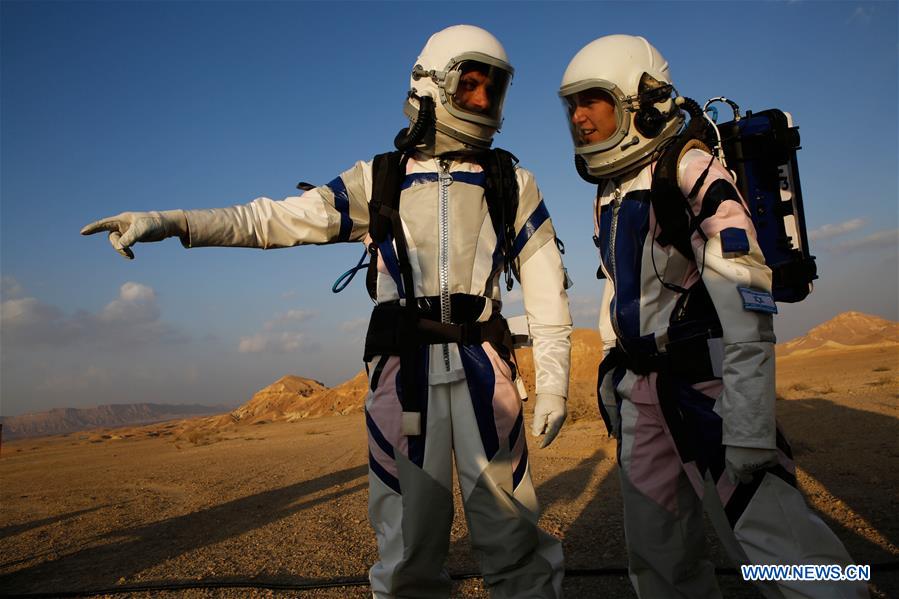
Israeli analog astronauts take part in the D-Mars project at the Desert Mars Analog Ramon Station in the Negev Desert near Mitzpe Ramon, Israel, on Feb. 18, 2018. A four-day-long Mars habitat experiment by six Israeli scientists ended on Sunday in the country's Negev desert. (Xinhua/Gil Cohen Magen)
by Keren Setton
JERUSALEM, Feb. 19 (Xinhua) -- A team of six Israeli scientists finished a four-day simulation of life on the planet Mars on Sunday.
The mission was conducted in Israel's Negev desert in the south of the country near the Ramon crater, which is similar to Mars in terms of the land structure, geology, aridity, appearance and isolation.
It is the first Israeli space simulation center but not the only one in the world. The simulation is designed to investigate and simulate possible life on Mars. During the simulation, participants were cut off from the world, as they conducted research studies, constructed buildings that suited the conditions on Mars and wore space suits.
Israel, which has advanced space sciences, has only sent one astronaut to space so far. Although he was killed in the NASA Columbia space shuttle crash in 2003, it has not deterred the country from aspiring to send further astronauts to space. Israeli presence in global space programs is minor so far.
Israel's space agency is a main sponsor of the event, together with leading universities, research centers and hi-tech companies in the country.
The conditions in the shipping container mimic those on the red planet, aside from the lack of atmosphere and the reduced gravity. Outside, the Negev desert also serves as a location with many similarities to Mars. It is an isolated, dry area with stark geological resemblance to the distant planet.
For Professor Guy Ron, a nuclear physicist from the Hebrew University in Jerusalem who was one of the six people inside the simulator, the desolate setting was the greatest challenge. He was responsible for the study on measuring cosmic radiation.
"It is truly the defining factor, you are far away from everybody," he said. "I'm such an online person, being offline for four days was challenging and interesting."
During the days of the experiment, the scientists were held up in the container and got to know each other intimately.
"Unlike real astronauts, we did not get a chance to get to know each other before. We talked a lot," said Prof. Ron. "Bunking with someone is a great way to get to know them."
The primary goal of the experiment was familiarization with the aspects of any mission to Mars. The participants were not only in an enclosed environment. They got accustomed to moving around in a cumbersome spacesuit with a heavy helmet on their heads.
The scientists also got used to the delay in communication between Mars and Earth. In real life this is facilitated by a satellite uplink which makes for at least a three-minute lag between the two sides. Often this time period is significantly longer.
Between them, they communicated with handheld radios.
"I absolutely understand now how hard it is to do good science in these kind of conditions," Dr. Reut Sorek Abramovich told Xinhua on the site. Abramovich is a scientific advisor at the Davidson Institute of Science and Education, the education arm of the Weizmann Institute of Science.
She was responsible for three simulation experiments, including a study to search for life using the collection of soil samples, exploring the feasibility of 3D printing using local soil and a psychological study on the effect of isolation and tension on the astronaut's functioning.
Later this year, students from the institute are slated to take part in a shorter experiment.
The long term aim is to enable research in areas of food technology, communications and remote sensoring.
The difficulties that emerged during the simulation brought with them a lot of lessons for the future.
"I would definitely use more robotics," Dr. Abramovich told Xinhua.
She was the 2nd female in the team together with four males.
"You need a certain type of mindset for women to survive with men," she laughed, hoping to see many more female astronauts in the future.
Mars exploration is still much about dreams and hopes and less about reality.
But for Prof. Ron, the reality is closer than many people think.
"Kids that are in school now will be going to Mars," he believes.