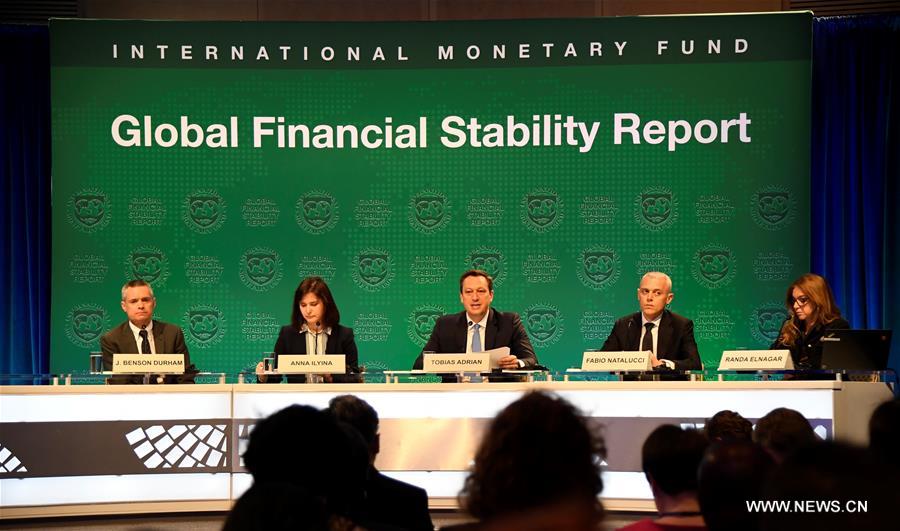
Tobias Adrian (3rd R), financial counsellor and director of the monetary and capital markets department of International Monetary Fund (IMF), speaks about the newly-released Global Financial Stability Report in Washington D.C., the United States, April 18, 2018. In a newly-released report, the IMF has forecasted a world economic recovery, predicting global growth at 3.9 percent for the year 2018. (Xinhua/Yang Chenglin)
WASHINGTON, April 19 (Xinhua) -- In a newly-released report, the International Monetary Fund (IMF) has forecasted a world economic recovery, predicting global growth at 3.9 percent for the year 2018.
The report World Economic Outlook said that at 3.8 percent, global growth in 2017 was the fastest since 2011; and with financial conditions still supportive, global growth is expected to tick up to a 3.9 percent rate in both 2018 and 2019.
However, analysts said major risks, including the rise of protectionism, threaten to derail global growth and are likely to hinder the broad-based momentum of recovery.
SWORD OF PROTECTIONISM HANGS OVER GLOBAL RECOVERY
IMF Managing Director Christine Lagarde said in a recent speech that after six years of disappointing growth, the world economy is gaining momentum as a cyclical recovery holds out the promise of more jobs, higher incomes, and greater prosperity going forward.
According to the IMF, the global economic recovery is supported by "strong momentum, favorable market sentiment, accommodative financial conditions, and the domestic and international repercussions of expansionary fiscal policy in the United States."
However, Lagarde said that there are clear downside risks: political uncertainty, including in Europe; the sword of protectionism hanging over global trade; and tighter global financial conditions that could trigger disruptive capital outflows from emerging and developing economies.
Maurice Obstfeld, economic counsellor and director of research at the IMF, warned that "the prospect of trade restrictions and counter-restrictions threatens to undermine confidence and derail global growth prematurely."
"That major economies are flirting with trade war at a time widespread economic expansion may seem paradoxical -- especially when the expansion is so reliant on investment and trade," he said.
Obstfeld called for "dependable and fair dispute resolution" within a strong rule-based multilateral framework to address intellectual property concerns and other "inequitable trade practices."
"There is room to strengthen the current system rather than risk bilateral fragmentation of international trade," he said, adding that multilateral cooperation remains essential to addressing a range of challenges, including climate change, infectious diseases, cyber-security, and the governance of world trade.
"Global interdependence will only continue to grow and unless countries face it in a spirit of collaboration, not conflict, the world economy cannot prosper," he said.
LOOSE GLOBAL FINANCIAL CONDITIONS
As the pace of global economic recovery is accelerating, many developed economies are considering promoting the normalization of their monetary policies.
Obstfeld said global financial conditions remain generally loose despite the approach of higher monetary policy interest rates.
Tobias Adrian, financial counsellor and director of the monetary and capital markets department of the IMF, said the still easy financial conditions continue to support global growth in the short term.
But there has been a buildup of medium-term vulnerabilities which have accumulated during years of low interest rates, Adrian said.
"Vulnerabilities may make the road ahead bumpy, and could put growth at risk," he said.
According to the Global Financial Stability Report of the IMF, there are three main vulnerabilities facing the world economy; the first one is that valuations of risky assets are stretched, across many markets.
The second vulnerability is that emerging markets and low-income countries could face a sudden tightening in global financial conditions, and such an event could lead to a reduction in capital flows, said the report.
The third is that there is a structural U.S. dollar mismatch among non-U.S. banks, even though banks have improved their resilience since the global financial crisis, according to the report.
"This could leave banks exposed to dollar funding problems in the event of strains in markets," Adrian said.
NON-ECONOMIC RISKS
In addition, non-economic risks are also threatening global economic growth, such as geopolitical tensions, the Brexit negotiation in Europe, climate change as well as ageing populations in some countries.
According to the IMF, the Brexit negotiation is the major political uncertainty. What's more, conflicts in the Middle East and Africa as well as forces of anti-globalization have added to the uncertainties in the fiscal policies of developed economies.
Analysts said that in the long run, the world economy is faced with challenges of demographic changes and ageing populations. In developed economies like Germany, Japan and South Korea, a reduced workforce will hinder potential economic growth.
The IMF has warned that these risks are inter-related and are very likely to hit the world economy hard.
It said the current economic recovery offers a window of opportunity to advance policies and reforms that secure the upswing and raise medium-term growth to the benefit of all.
"Such policies should focus on strengthening the potential for higher and more inclusive growth, building buffers to deal more effectively with the next downturn, improving financial resilience to contain market risks and stability concerns," said the IMF.