By Yi Ling
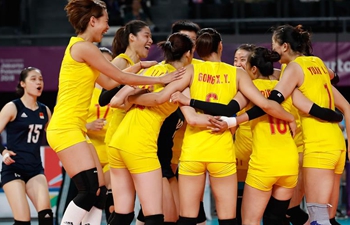
JAKARTA, Sept. 1 (Xinhua) -- When Bahraini runners brought home 12 gold, six silver and seven bronze medals as of the end of the athletics competition at the Asian Games, the most in the Gulf state's history, the team's head coach Jose Ludwig Rubio celebrated the achievement in an Instagram post.
"25 medals in this historic Asian Games. Congratulations to all athletes, coaches, federation officials and specially for Mr. Bin Jalal for his great support to our Bahrain athletics team during the year," wrote the Dominican accountant.
The Mr. Bin Jalal referred to was Mohammed Abdullatif bin Jalal, the vice-president of Bahrain Athletics Association. And the athletes - at least 20 of whom were born outside Bahrain and were brought in to help the country flourish athletically - are a source of pride for Ludwig Rubio, who has worked for the Bahrain Athletics Federation since November 2017.
These African-born medal winners, mostly from Nigeria, Kenya, Morocco and Ethiopia, who have won most of the medals for the country that they changed allegiance to compete for in Jakarta, represent a special group at the international sports events: naturalized athletes.
Although not new to the Asian Games, naturalized athletes have had increasing influence in recent years.
Taking the Jakarta Asiad as an example, Bahrain, with its all 25 medals from the track events in Jakarta, outranked the athletic powerhouses Japan, South Korea and India in the medal tally of athletics, surging to the second place in the medal standings behind China. Just eight years ago at the Guangzhou Asiad, it won only five golds and four bronzes.
These naturalized athletes have given rise to mixed feelings across Asia.
The bright side is that these elite foreign-born athletes can promote exchanges with their native counterparts in skills and techniques.
For example, Japanese runner Sho Kawamoto, who finished seventh in the men's 800m final, said he was stimulated by the naturalized athletes in the races.
"They have received world-class training and usually they bring a higher-level competition. Their existence here is absolutely helpful for us to run faster," said Kawamoto.
Defending champion of women's 100m Wei Yongli from China, despite being beaten by Nigerian-born Bahraini Edidiong Odiong in Jakarta, also agreed that the presence of naturalized athletes helped to raise the athletics level of Asia, but admitted that it was "a little bit unfair too."
On the other hand, concerns are mounting over a possible wild expansion of naturalization in Asian sports.
Xu Jiamin, head coach of the Chinese women's basketball 3x3, sees the practice of naturalization as both an opportunity and a challenge.
"The naturalized athletes will improve their team's performance and the sport's level, but if they were overused, domestic players would have few chances to get practical experience. So to keep a balance, a team should better be made up mostly by domestic players and naturalized athletes can use their skills and experiences to support the team," Xu suggested.
"Every coin has two sides," said Shivani Satishi of Indian Express. Satishi noted that Indian star female sprinter Dutee Chand was beaten by Odiong twice in the women's 100m and 200m to end with two silvers.
"We are proud of Chand's winning silvers. We can't say it's fair or unfair, because they 'naturalized athletes' do this following the rules. Nothing we can do about that," she said.
Satishi agreed, and says that the introduction of foreign-born elites is a helpful way to promote the development of a sport in the long run.
"The point is we can find a sort of balance by setting limits on the number of naturalized athletes on the court and the time of their play. But in the case of individual event in athletics, what shall we do?"
Toshimi Oriyama of Japan, a senior sports news writer who is here to cover the Asian Games, is very cautious about the overall effect of naturalization.
"If the level gap between naturalized and domestic players is too big, it's hard for the naturalized athletes to merge into the team or to bring strong encouragement or stimulation to their teammates," he warned.
Tian Bing, a senior Chinese sports freelancer who covers athletics, has been following the athlete naturalization for years. He believes that uncontrolled naturalization brings moral challenges to sportsmanship and says that taking short cuts to medals by taking advantage of naturalized athletes will backfire in the long run.
"Since the athletes are often remunerated and earn their living from sporting performance, their motivation is often to acquire, stabilize and increase their financial gains in agreeing their naturalization. Thus, a sporting nationality tends to turn into financial asset," said Tian.
"Under this condition, I see nothing but deals," he said. "Sportsmen and sportswomen are supposed to be role models for their spirits of fighting till the end, fair play, or breaking records. Those who compete for sheer benefits, but not out of love for sports, can never win respect from others."
In addition, Tian says that the recruitment of foreign athletes is likely to weaken or phase out efforts to train young domestic players.
"It's not fair for domestic players as they are facing fewer resources and opportunities for competition. Thus the sports development of host countries will suffer in the long run," he added.
To win medals in competitions like the Olympics, Asian Games or World Championships in athletics, countries must boost an already-established talent development program at the national level. To run such a program, countries need both money and time.
Money guarantees the material conditions to nurture elite talent; time allows national talent development programs to make local alliances to help scout prospective athletes.
Tian suggested that the host countries of naturalizing athletes ought to put more effort into finding and developing national talents and give more attention to sculpting the athletes that are already there.