 ?
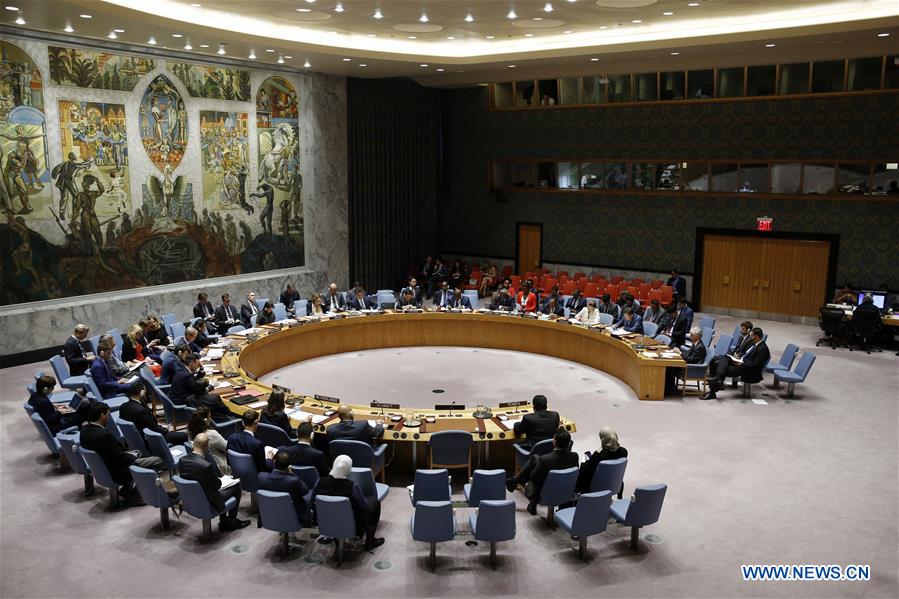
?The United Nations Security Council holds a meeting on the situation in Yemen, at the UN headquarters in New York Sept. 21, 2018. UN Undersecretary-General for Humanitarian Affairs Mark Lowcock on Friday warned of the danger of widespread famine in Yemen amid economic meltdown and fighting threatening the lifeline of supplies for civilians. (Xinhua/Li Muzi)?
UNITED NATIONS, Sept. 21 (Xinhua) -- UN Undersecretary-General for Humanitarian Affairs Mark Lowcock on Friday warned of the danger of widespread famine in Yemen amid an economic meltdown and fighting that threaten the lifeline of supplies for civilians.
"The Security Council has asked for an update today on the humanitarian situation in Yemen. In a word, it is bleak," said Lowcock. "We are losing the fight against famine."
The situation has deteriorated in an alarming way in recent weeks, he told the Security Council. "We may now be approaching a tipping point, beyond which it will be impossible to prevent massive loss of life as a result of widespread famine across the country."
Some 18 million of the 29 million Yemenis, including a high proportion of children, are food insecure, and more than 8 million of them severely food insecure, meaning they do not know where their next meal will come from and they need emergency food assistance to survive, said Lowcock.
The already dire humanitarian situation was battered by a marked economic deterioration, symptomized by the depreciation of the Yemeni rial by some 30 percent in the past month or so, said Lowcock.
Because almost all the food consumed in Yemen is imported, that depreciation translates directly into a sharp increase in the price of food for some 10 million Yemenis who are food insecure but who are not reached by international aid.
"We are already seeing pockets of famine-like conditions, including cases where people are eating leaves because they have no other form of sustenance," he said. "We estimate that an additional 3.5 million people may soon be added to the 8 million already severely food insecure."
Compounding that, the depreciation of the rial and access problems are producing unprecedented increases in the price of fuel. As petrol prices have doubled just this week, transportation costs have gone up, and reaching a health facility or fleeing fighting is becoming unaffordable for many families without outside help, said Lowcock.
Commercial imports of food and fuel have yet to recover from last November's blockade of seaports by the Saudi-led coalition, he said.
With the confidence of shipping companies already very battered, as reflected in a 35 percent drop in clearance requests since the blockade, any further shocks could add to the core humanitarian caseload in a way which would simply overwhelm the capacity of humanitarian organizations, he warned.
The intensification of fighting in recent weeks around the Red Sea port of Hudaydah is choking the lifeline which the aid operation -- and the commercial markets -- rely on, he said.
The main Hudaydah-Sanaa road -- the principal artery used by commercial importers and humanitarian organizations to move commodities to people across the country -- has been cut off by fighting. Other routes are heavily damaged and increase transport times and therefore the cost for humanitarian organizations and private companies, he said.
The Red Sea mills in Hudaydah, containing 45,000 tons of grain imported by the World Food Programme, which is enough to feed 3.5 million people for a month, has recently been inaccessible because of fighting in the area, he said.
Armed groups have occupied humanitarian facilities. Attacks against civilians and humanitarian sites have resulted in dozens of deaths and serious damage to public health and water facilities and other humanitarian assets, said Lowcock.
Aid agencies, including the United Nations, still have over 600 staff in Hudaydah. But aid activities, including life-saving immunization campaigns, have been delayed or prevented, he said.
Lowcock asked the Security Council to take immediate measures to stabilize the economy and support the exchange rate.
That includes useable liquidity for Yemen's central bank, and the implementation of long-standing commitments to pay key public-sector salaries across the country, so that more people have the wherewithal to buy food and keep the commercial markets alive. It is, at the same time, essential to avoid any policy measures that would damage "the already paper-thin confidence" of commercial importers any further, said Lowcock. International aid cannot replace the commercial markets, he noted.
Meanwhile, all stakeholders must uphold their obligations to protect civilians and civilian infrastructure and facilitate access to vulnerable people, he said.
"We have to keep all ports open; we have to keep main roads open; we have to keep them functional; we have to keep them safe. No humanitarian site should be used for military purposes. The lifeline through which the aid operation runs now hangs by a thread."
He asked all parties to the conflict to find practical solutions to key issues, including the opening of an air bridge for civilians to seek medical treatment outside Yemen for diseases no longer treatable inside the country. And of course, the parties need to get around the negotiating table and engage seriously with the UN mediator on a positive path toward peace, he said.
"While we will continue to push to scale up the humanitarian response, humanitarian organizations simply cannot look after the needs of all 29 million Yemenis. That is untenable."
Yemen has been in civil war in the past three years, pitting Houthi rebels and forces loyal to the government of Abdrabbuh Mansur Hadi. Saudi Arabia leads an Arab military coalition to support the Hadi government.