KUNMING, Jan. 26 (Xinhua) -- When He Guiying was a little girl, she used to shut her door to passers-by who didn't speak her ethnic language, just like her parents and other Jinuo villagers would.
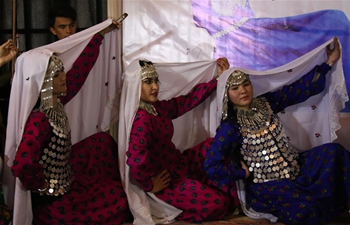
But now, the 52-year-old tea planter and dancer has traveled to many cities across China to perform her people's traditional "drum dance" and presented it to millions of audience members on TV.
Her ethnic group, Jinuo, was the last of the 56 ethnic groups officially recognized by the Chinese government in 1979.
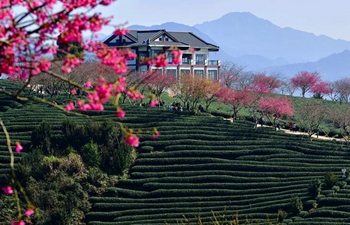
Most Jinuo live in He's hometown -- Jinuo Ethnic Township, Jinghong City in southwest China's Yunnan Province. The area boasts a long history of tea cultivating on Jinuo Mountain, once regarded as one of the six great tea mountains as early as the Qing Dynasty (1644-1911) with ancient tea trees over 500 years old.
However, geographic isolation and poor infrastructure restrained the township's development, overshadowing its past glory and leading to a lack of confidence among local people.
In 1978, the average annual income for locals was 106.85 yuan.
"People did not even speak to strangers, let alone do business with them," said 44-year-old Bai Lan, head of the township government.
Since 2015, guided by local government, Xiaopuxi village in the township first tried to invigorate tea business through improving infrastructure, forming industrial cooperatives and applying modern industrial standards.
"We've focused on boosting our value by updating technology and building our own brand, and we found that products of our ancient tea trees sell very well," said Wang Chao, Party chief of the township.
Last year, the average income per person reached 11,757 yuan (1,733 U.S. dollars) and the tea industry generated an income of over 43.6 million yuan in 2018 for the township.
A total of 574 people in 162 households have shaken off poverty over the past four years.
As incomes and livelihoods get better, Wang also witnessed a change in local mentalities.
"Jinuo people no longer fear communication with the outside world. Look around and you will find people, even elderly people, being very glad to talk to you. We are now eager to reach out," said Wang, noting that local people are now using the Internet to sell their tea products.
Over 200 kilometers away from Jinuo, tea planting also changed the fate of 76-year-old Su Guowen and his ethnic group -- Bulang.
"I am a living witness of how electricity, roads and concrete houses have come to our village step by step. It's like traveling through two centuries in one lifetime," said Su, a prestigious senior in Yunnan's Mangjing village, Pu'er City.
In 2004, under Su's proposal and support from the local government, the village began to revive its tea cultivating tradition and return farmland into forests.
Villagers made every possible effort to protect the environment so the tea trees could maintain the natural taste of their leaves. Mountain roads near tea plantations were paved with stones instead of cement.
After more than a decade's development, 10 tea cooperatives in Su's locality established an alliance in 2016 to regulate production practices in the booming industry. Villagers from different ethnic groups are also encouraged to get on board.
In 2018, the average annual income for each of the 2,800 plus tea planters in Mangjing reached 11,532 yuan, according to local government.
"We are now working on building ecological tea plantations with stricter standards -- from raw material, processing to pricing. It is the key to our future development and poverty alleviation task," Su said.
Wang has a similar plan of fighting poverty for villagers in Jinuo with a tea business. But his ambition reaches beyond.
"Our short-term goal is to leave no one beneath the poverty line, and our long-term vision is to do business with the whole world and let the world know us," said Wang.