




by Xinhua writers Liu Xinyong, Zheng Xin, Zhang Zhongkai
BEIJING, March 8 (Xinhua) -- With a new draft foreign investment law submitted to national lawmakers for a third reading, China is a big step closer to adopting a unified "fundamental law" that will better protect foreign investors and start a new chapter for its opening up.
Friday afternoon, Wang Chen, vice chairman of the Standing Committee of the National People's Congress (NPC), made explanatory remarks on the new draft to deputies attending the second session of the 13th NPC at the Great Hall of the People.
"The law is a full testament to China's determination and confidence in opening wider to the outside world and promoting foreign investment in the new era," Wang said.
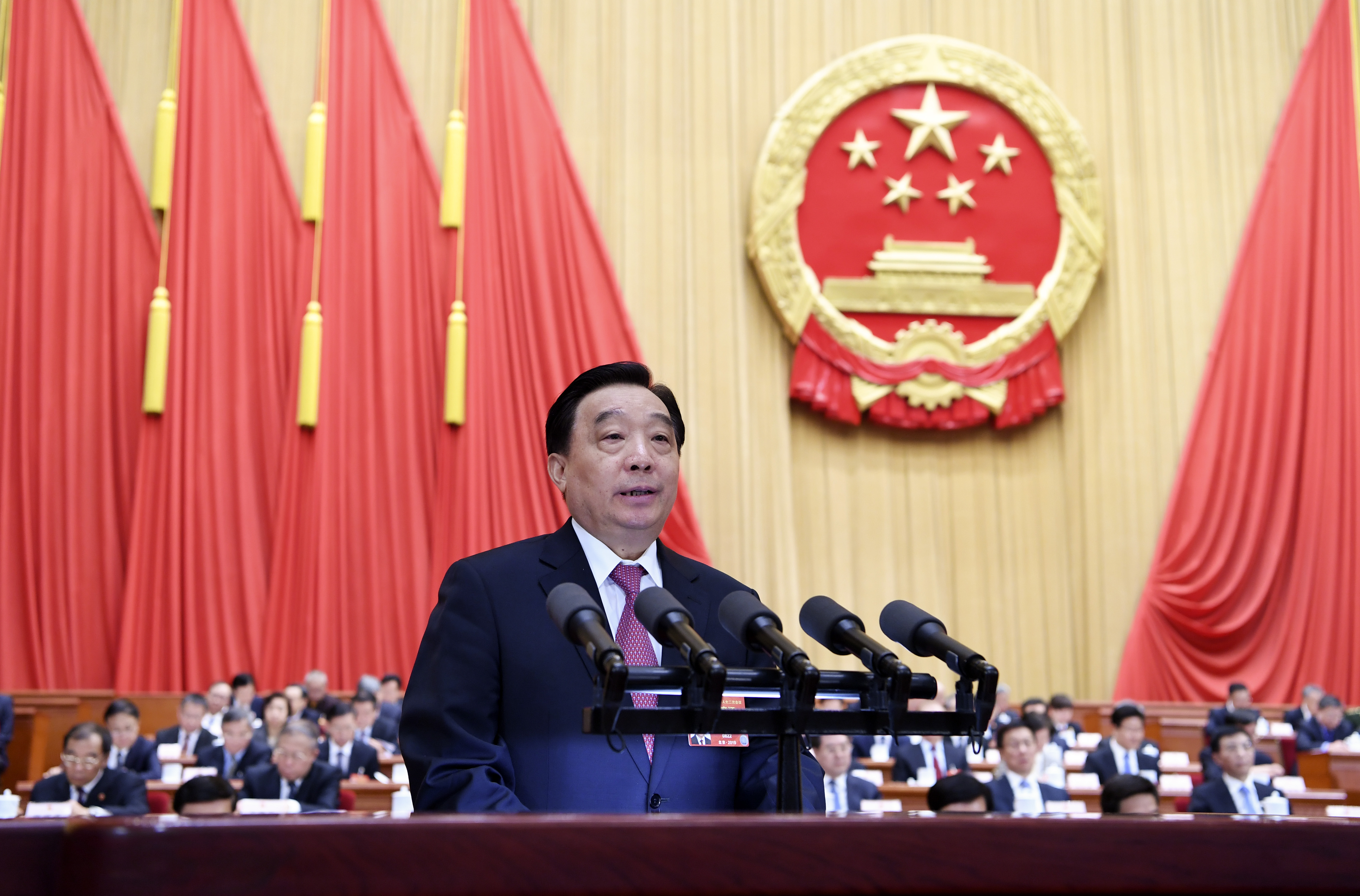
Wang Chen, vice chairman of the National People's Congress (NPC) Standing Committee, makes an explanation on the draft foreign investment law during the second plenary meeting of the second session of the 13th NPC at the Great Hall of the People in Beijing, capital of China, March 8, 2019. (Xinhua/Zhang Ling)
A FUNDAMENTAL LAW
"With unified provisions for the entry, promotion, protection, and management of foreign investment, it is a new and fundamental law for China's foreign investment and an innovative improvement of China's foreign investment legal system," Wang said.
It is a comprehensive and fundamental set of legal standards for foreign investment activities in China under new circumstances, and shall play "a leading role as an overarching law in this field."
Once adopted, the unified law will replace the three existing laws on Chinese-foreign equity joint ventures, wholly foreign-owned enterprises and Chinese-foreign contractual joint ventures.
Soon after China embarked on the journey of reform and opening up, the law on equity joint ventures was put into effect in 1979, laying the legal foundation for attracting foreign investors. The latter two were enacted in the 1980s responding to the different needs of foreign investors.
"Foreign investment in China has been carried out under the rule of law from the very beginning," said Li Chenggang, assistant minister of commerce.
The three laws served as a window for the market economy to absorb foreign capital under the planned economy at that time, and helped China's foreign-related economic legislation grow from scratch, said Zhang Yuejiao, professor with Tsinghua University and former chair of WTO Appellate Body.
Wang said the three laws have provided strong legal safeguards for foreign enterprises, but they are no longer able to meet the needs of reform and opening up in the new era.

Photo taken on May 16, 2018 shows an automatic container dock in Qingdao, east China's Shandong Province. (Xinhua/Wang Peike)
RESOLVE TO OPEN WIDER
Over the past decades, China has made substantial achievements in attracting foreign capital. By the end of 2018, about 960,000 foreign-invested enterprises had been set up in China, with the accumulated foreign direct investment (FDI) exceeding 2.1 trillion U.S. dollars.
FDI into China has ranked first among developing countries for 27 consecutive years, according to the United Nations Conference on Trade and Development (UNCTAD).
The new law shows China's will and determination to follow through with reform and opening up in a new historical context, and links Chinese circumstances with international rules, Wang Chen told deputies.
"The law will further ease market access and promote long-term operations for foreign investors," said John Williams, managing director for partnership and government affairs at International SOS China and Asia Pacific, adding that it demonstrates China's full confidence of competing on the global stage.
The draft makes it clear that the state shall manage foreign investment according to the system of pre-establishment national treatment plus a negative list.
It aims to improve transparency of foreign investment policies and ensure domestic and foreign enterprises are subject to a unified set of rules and compete on a level playing field.
During the lawmaking process, China has absorbed the latest international regulations and trends, reflecting China's strong determination to further open to the outside world, Zhang said.
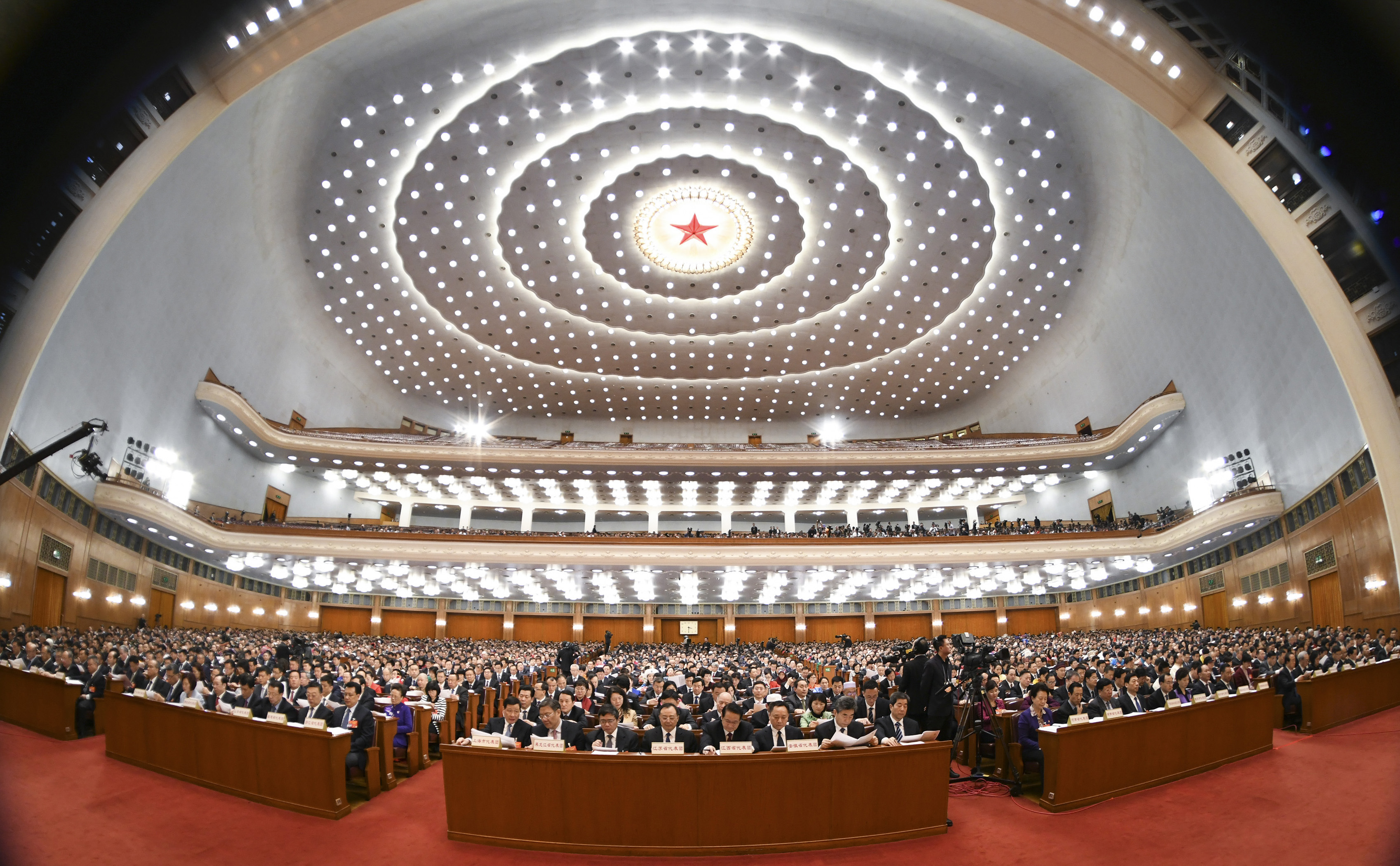
The second plenary meeting of the second session of the 13th National People's Congress (NPC) is held at the Great Hall of the People in Beijing, capital of China, March 8, 2019. (Xinhua/Zhang Ling)
MORE ATTRACTIVE MARKET
Last year, non-financial FDI into China stood at roughly 135 billion U.S. dollars, the world's second largest and up slightly from the previous year. In contrast, the world's total FDI inflow dropped 19 percent, with developed countries suffering a plunge of 40 percent.
China is currently home to more than 2,000 regional headquarters and R&D centers of multinationals, showing the confidence in and recognition of the country's business environment.
In 2018, China advanced to a global ranking of 46 in terms of ease of doing business, up from 78 in 2017, according to a World Bank Group report released last year.
"This shows the constant improvement in our business environment, and greater progress might be made this year," said He Lifeng, head of the National Development and Reform Commission.
The draft law's clauses on key issues like pre-establishment national treatment are based on transparency, predictability and fairness, said Rachel Duan, senior vice president of General Electric.
"We look forward to its rollout, and expect it to further boost global confidence in China's economy and promote high-quality development," Duan said.
The law will be significant in promoting trade liberalization and facilitation, Zhang Yuejiao said.
China has reaffirmed its pledge that it will not close its door to the world but will only become more and more open, Zhang said. "China is going to continue achieving win-win cooperation with investors from around the world."
Looking ahead, the new law will offer foreign firms legal protection that keeps up with the times, and makes China a magnet for more and more multinational companies, Williams said. Enditem
(Xinhua reporters You Zhixin, Xu Xiaoqing, Li Kun, Panjie and Yu Jiaxin contributed to the story.)
