URUMQI, May 20 (Xinhua) -- Herder Ahmat Abla is considering returning to a profession abandoned by his people almost 100 years ago -- fishing.
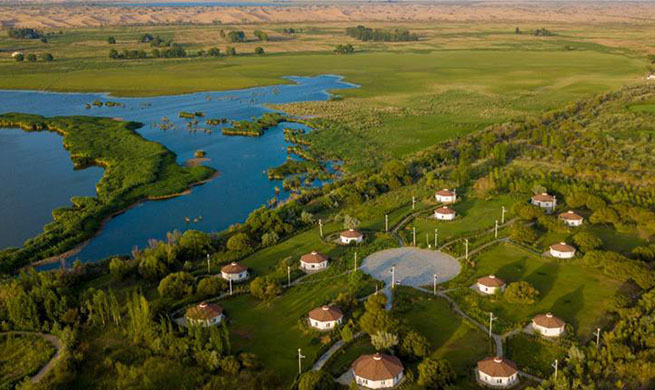
Ahmat currently grazes his sheep flock on a small pasture near the lower reaches of the Tarim River, China's longest inland river. Once upon a time, there were dozens of dried-up ponds and lakes dotted around the pasture, but thanks to an improved ecosystem, fish are returning to those waters.
The 38-year-old says his father once grazed flock in this area of northwest China's Xinjiang Uygur Autonomous Region, which he described as being "barren and more like a desert back in the day."
The Tarim River runs 1,321 km along the rim of the barren Tarim Basin, a sparsely populated area about the size of Poland.
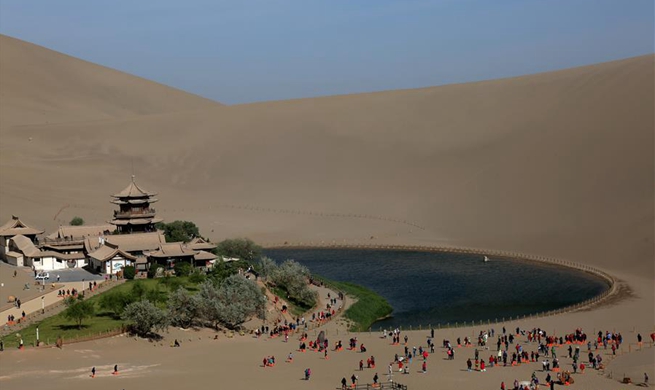
Excessive irrigation in the past used up too much water, which caused the 400-km long lower reaches of the Tarim River to run dry in the early 1970s and pushed surrounding trees to the verge of disappearance.
Born in the village of Yengisu by the dried-up river, Ahmat never saw river water as a child. Sand would slowly cover the caked riverbed. To find water, Ahmat's family and flock had to move 200 km up north.
"My grandfather once told my father that we are descendants of the Lop Nur people," says Ahmat.
According to locals like Ahmat, the Lop Nur people fished for food in the area famous for the vast Lop Nur lake, where historically the Tarim River ended. The lake dried up not long after the water in the river had gone. As such, many fishermen packed up their rods to pursue herding and farming.
"When I was a child, I never ate fish. Nor did I ever see my grandfather or father go fishing," says Ahmat.
A young Ahmat never tasted fish, but he knew too well the taste of sandstorms.
"When the 'black storms' struck, I could see nothing, and the sheep couldn't find their way home," he recalls the sandstorms in the old days.
"Nothing could be seen when a black storm hit, and nothing was left after the storm," says Wang Jianben, 74, who lives on a farm some 100 km away from Ahmat's village.
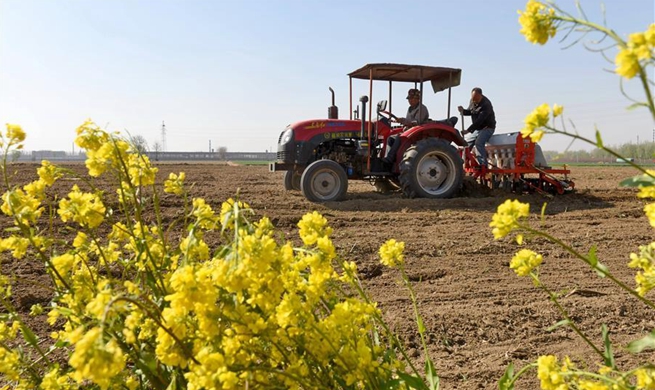
"Most of the crops would be blown away, and the farmers had to replant the crops three to four times in a single spring."
Before his retirement, Wang irrigated farmland for decades and witnessed local farmers' continuous battles against sandstorms.
"It didn't just feel like a black storm, it was as if the whole desert was approaching," recalls Liu Conghui, a writer who was born, and still lives, near the farm Wang once worked.
As the menacing sandstorms made the area increasingly inhospitable, Liu's whole community planned to up sticks.
To restore the local ecosystem, the Chinese government launched a 10.7 billion yuan (1.6 billion U.S. dollars) project in 2001. A set of measures were adopted such as saving water, converting farmland into grassland, providing treatment for dry riverways and building dams. In addition to those measures, industrial and agricultural use of water in cities and counties along the river was limited.
Over the past two decades, Xinjiang has infused 7.7 billion cubic meters of water to the dry trunk stream of the lower reaches of the Tarim River in 19 rounds of water diversion.
Statistics show that a total of 2,285 square km of vegetation along the lower reaches of the river has been restored or improved thanks to the irrigation project. Meanwhile, the area of sand has been reduced by 854 square km.
In the end, the resettlement plan for Liu's community was never implemented, so he still lives where he was born. He can now grow fruit and vegetables in his yard, and often invites friends over for barbecue parties.
Although there is still occasional spells of dusty weather in early spring, "black storms" are certainly a thing of the past.
"I hope it is just a memory of our generation and will never be passed on," says Wang.
With the ponds and lakes refilled with water and pastures regaining lush grass, Ahmat can now enjoy grazing his some 300 sheep in the spring breeze.
Ahmat recently fell in love with boiled fish, but is yet to master making the Lop Nur people's signature meal -- grilled fish.
"I've seen a lot of grass carp and common carp in the water. I must learn to make a living from them, as my ancestors once did," he says.