




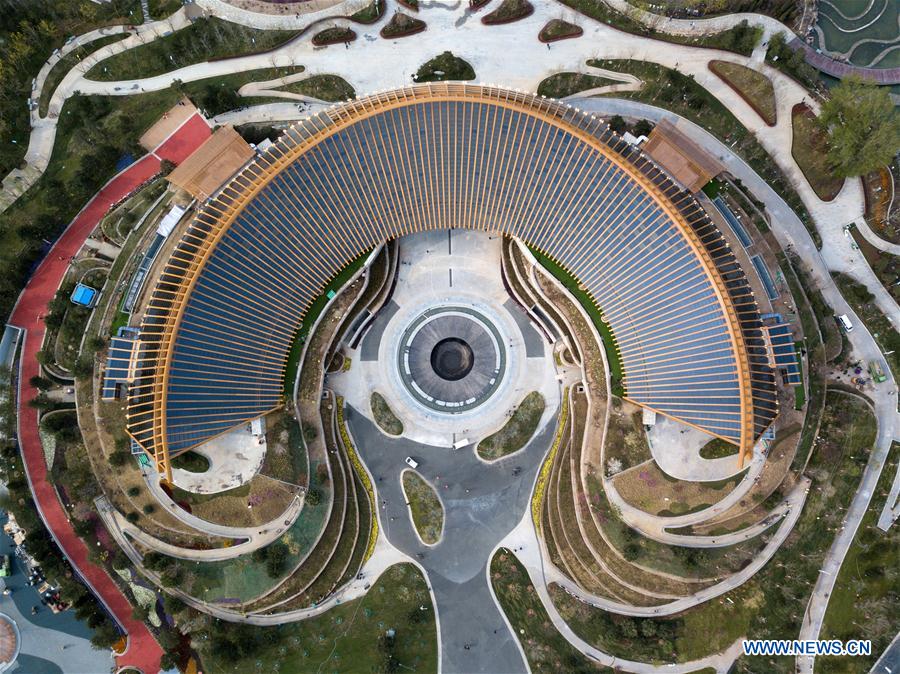
Aerial photo taken on April 19, 2019 shows the Chinese Pavilion of the 2019 Beijing International Horticultural Exhibition in Yanqing District of Beijing, capital of China. (Xinhua/Ju Huanzong)
BEIJING, June 6 (Xinhua) -- From Chinese plums and orchids to chrysanthemums and peonies, flowers of the four seasons blossomed with horticulturist techniques in the Chinese Pavilion at the Beijing International Horticultural Exhibition, as China celebrated its national pavilion day on Thursday.
Featuring a design of Ruyi, an auspicious ornamental object in the Chinese culture, the Chinese Pavilion is a significant symbolic venue in the 503-hectare expo site at the foot of a section of the Great Wall in Beijing's Yanqing District.
About 950 guests from home and abroad were invited to watch theatrical performances on the China Pavilion Day and enjoy the flower show.
"By welcoming the world here, China is urging all nations to address environmental sustainability and enhance the quality of life for future generations. At the very highest levels, China is driving the way forward in the construction of an ecological civilization, a mission that is exemplified here, at Expo 2019," said Steen Christensen, president of the General Assembly of the Bureau International des Expositions at the National Day of China Pavilion celebration.
"The essence of Chinese gardening is all in one piece," said Guo Jia, a horticulture official of the expo's coordination bureau.
Nestled by the semi-circular building, there is a pasturable garden. The architectural design embodies China's agricultural-based cultural identity and the Chinese wisdom of learning and following the nature, said Cui Kai, chief designer of the China Architecture Design and Research Group, who took charge of the pavilion design.
The building covering 23,000 square meters is the largest pavilion in the exhibition. Designers take it as a "miniature" to manifest China's horticulture, architecture, engineering, land management, forestry, fine arts and even psychology of harmony, cohesion and inclusiveness.
Half of the walls of the building are covered with terraces where agricultural and flower plants are grown.
The traditional Chinese architectural roofs collect rainwater to the terraces like the method used in the traditional Chinese courtyard. The energy supply system in the building is boosted by more than 1,000 photovoltaic panels in flower patterns.
Cui said the pavilion design combines the traditional architectural wisdom of adapting measures to natural conditions while using energy-saving technology to improve the functions.
The world's largest expo of its kind opened on April 29 and will last until Oct. 7. Since its opening, the expo's four major pavilions have seen more than 4.7 million visitors, among which the China Pavilion had received over 1.43 million visits as of Wednesday, according to the expo's coordination bureau.
Themed "Live Green, Live Better," the expo has attracted exhibitors from 110 countries and international organizations to exhibit indoor displays and outdoor gardens, highlighting the integration of life and ecology.
A LONG HISTORY
China boasts a long history of horticulture and ancient Chinese had pursued a philosophy of harmony between man and nature thousands of years ago.
An exhibition is going on underground the Chinese Pavilion, themed 24 plant species and their specimens recited in the Classic of Poetry, or the Book of Odes, which is the earliest existing anthology of poetry in China dating from the 11th to 7th centuries BC.
The specimens are arranged with verses referring to the plants quoted from the poetry classic.
"The peach tree beams so red. How brilliant are its flowers.
The maiden's getting wed. Good for the nuptial bowers."
Along with the verse, a peach pit unearthed from the 7,000-year-old Hemudu culture ruins in east China's Zhejiang Province is exhibited with explanatory notes saying how the plant species was dispersed to Persia via the ancient Silk Road and then to other parts of the world.
Zhang Lie, director of Interaction Media Design Institute of the Academy of Arts & Design, affiliated to Tsinghua University, said among over 300 ancient poems collected in the classic, more than 100 mentioned plants either for appreciating their beauty or recording their edible and usage effects.
He said the words of flower, grass, fruit, forest and seedlings appeared in oracle bone inscriptions, known as the earliest Chinese characters of 3,000 years ago. They also appeared on pottery fragments of Hemudu culture period.
To further embody the impact that horticulture has had on Chinese art, the exhibition organizers used plant formations to showcase famous Chinese ink-wash paintings.
GREEN DEVELOPMENT
The horticulture expo is far from being a "showroom," as it demonstrates China's firm determination and confidence in pursuing green development.
During the construction of the exhibition site, about 50,000 trees remained untouched and in their original locations. Wang Shuqin, deputy director of the Gardening and Greening Bureau in Yanqing District, said the forestation along the Guishui River, next to the expo park, has greened the banks with over 13 hectares of woods since 2012.
Hectare by hectare, and district by district, China is developing from a contributor to a leader in terms of promoting green development.
More than 100 km away from the expo, Saihanba, a desert in the 1950s, has been turned into a scenery destination favored by tourists from Beijing, as more than 50 years of afforestation efforts have turned it into the world's largest man-made forest park in the world. In 2017, the Saihanba afforestation project won the UN Champions of the Earth Award for creating a vast man-made forest covering about 93,000 hectares in northern China and made great contributions to the restoration of degraded landscapes.
The canopies of Saihanba is still expanding and has become an important ecological barrier of Beijing. It is estimated that the number of days with sand and dust weather in the Beijing-Tianjin-Hebei region has decreased sharply by over 70 percent in the spring over the past decade.
The Chinese government believes in the "power of plants", and its policies for ecological development highlight this very clearly, said Tim Briercliffe, secretary general of the International Association of Horticultural Producers, at the Thursday event. "Expo 2019 Beijing is exposing millions of people, from around the world, to this vital message."
"It is the greatest event of its kind and a unique opportunity to embed and showcase the message that plants matter," Briercliffe said. "Anyone who has the chance to visit this magnificent Expo should do so, they will not regret it."
(Video reporters: Li Dexin, Tian Zhenxu, Pang Yuanyuan, Ma Xiaodong, Xia Zilin; Video editors: Zhu Cong)
