 ?
?
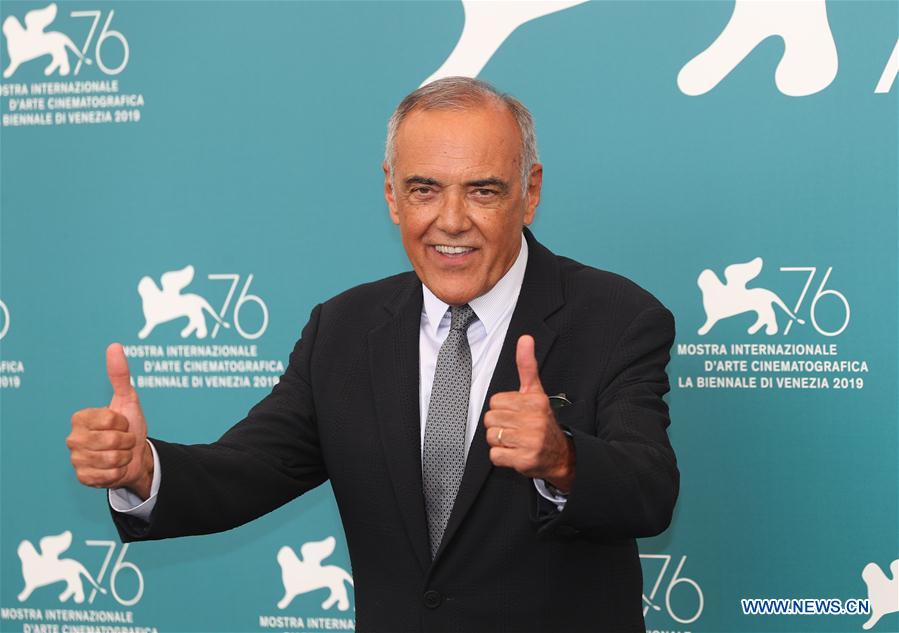
Venice Film Festival director Alberto Barbera poses for a photo in Venice, Italy, on Aug. 28, 2019. The digital evolution is bringing about the deepest transformation in cinema history, Venice Film Festival director Alberto Barbera told Xinhua in an interview at the ongoing 76th edition. (Xinhua/Cheng Tingting)
by Alessandra Cardone
VENICE, Sept. 6 (Xinhua) -- The digital evolution is bringing about the deepest transformation in cinema history, Venice Film Festival director Alberto Barbera told Xinhua in an interview at the ongoing 76th edition.
"In the relatively short history of this form of art -- no more than some 120 years -- we are in a phase of deep change of the entire film work process," Barbera said.
"Cinema is adapting very fast and deeply under the pressure of the new technologies, meaning it is nowadays much easier to make a film, and new technologies are offering new tools to tell stories in different ways."
Among major international film festivals, the one in Venice has in recent years appeared to be one of the most open to the new forms of producing, filming and distributing movies.
Since 2017, for example, the festival has added a competitive section devoted to virtual reality (VR). At the same time, productions by streaming platforms (such as Netflix and Amazon) were included in Venice's major competition and other categories, alongside films by Hollywood majors, international production companies and independent movies.
Barbera confirmed that the Venice festival's management strongly believes that the ongoing changes would benefit cinema overall.
"This (transformation) is very interesting, because access to production for young talents is easier than before," he explained.
"There is more money available ... the streamers, for example, will likely invest a huge amount of money in film production, and I think everybody will profit, not just the so-called auteur cinema but also the younger filmmakers."
BOOSTING QUALITY
Barbera further explained why he believed the digital evolution would also end up boosting quality. "There is going to be very strong competition among streamers ... and the competition will be on contents," Barbera stressed.
"They will indeed need new good-quality contents, because you cannot expect people to pay a monthly subscription to get access to film contents if you are not able to offer high-standard ones."
The main competition at the current 76th Venice Film Festival -- 21 films running for the Golden Lion -- was overall described as well worthy and varied.
SPECIFIC TRENDS
Besides including films from all over the world and approaching different topics in different aesthetics, the director said this edition presented some specific trends.
"One is the attention paid to all of the issues related to women," he noted.
"There are many female portraits, and many films reasoning about the women's condition in the different societies of today."
A second trend was a general attitude by many filmmakers to deal with major contemporary problems in our societies. Barbera said he had the impression that cinema was "re-discovering reality, being less tempted to escape in a world of fantasy."
He further elaborated that "I think different elements are playing a role under this perspective.
"One is represented by documentary films, which are proving increasingly interesting, so that the film industry is investing in them much more than in the past," Barbera explained.
"Some documentaries have also been awarded in festivals, and got commercial distribution, and a lot of them can be found on streaming platforms ... Hence, the audience finally seems much more interested in these kinds of works."
This affects fiction films as well.
"There is (now) a way to tell a story that is much more realistic than before, due to the fact that tools coming from documentaries are being used to make fiction films," Barbera went on.
"One reason why there were many films in the recent past inviting us to escape in fantasy realities was that making special effects had become easier and less costly.
"Now, we are learning to use those same special effects to tell, in a better way, traditional stories in films dealing with contemporary issues," he said.
OMINOUS ABSENCE OF CLIMATE CHANGE
Yet, Barbera said that one of the most pressing issues of our times -- climate change -- was surprisingly not much present this year in Venice, not even in the hundreds of entries submitted to the festival's committee.
"The truth is that we saw very few films dealing with this topic" also in the phase of selecting the entries, he stressed.
"This is quite strange, because (climate change) is one of the most serious problems we have today, and the topic is being discussed in the media, in politics ... But not yet in cinema, and I do not know why."
CHINESE MOVIES NEED MORE EXPOSURE
With regard to Chinese cinema, Barbera suggested some latest trends seen on the huge Chinese market -- the number of theaters still growing, but the average screen attendance not keeping pace with this -- would possibly reflect a new phase of transformation.
"China's cinema market has gone through a huge and very quick growth in recent years, and with unexpected successful results.
"Numerous theaters have been opened across the country -- also in regions where cinema simply did not exist before -- and this affected the production industry, because most of the films were made to address the local audience instead of an international one," Barbera observed.
This, he continued, ran counter to what had characterized Chinese films during the 1990s, which had appealed to a global audience.
"Now, I think the Chinese industry will likely go back to the previous situation, since they would start to realize that -- despite a huge domestic market -- Chinese films also need more international attention, through festivals, for example," he said.
To do this, Barbera suggested, China's cinema industry should "bet on different productions and support auteur cinema and films dealing with contemporary topics along with the commercial movies and comedies that are also very successful on the domestic market."
"I am quite optimistic ... We have a couple of Chinese films in this year's main competition, for example, as we had in recent years, so I think the situation is getting better and better," he said.
The 76th Venice Film Festival will run at the Lido until Sept. 7.