



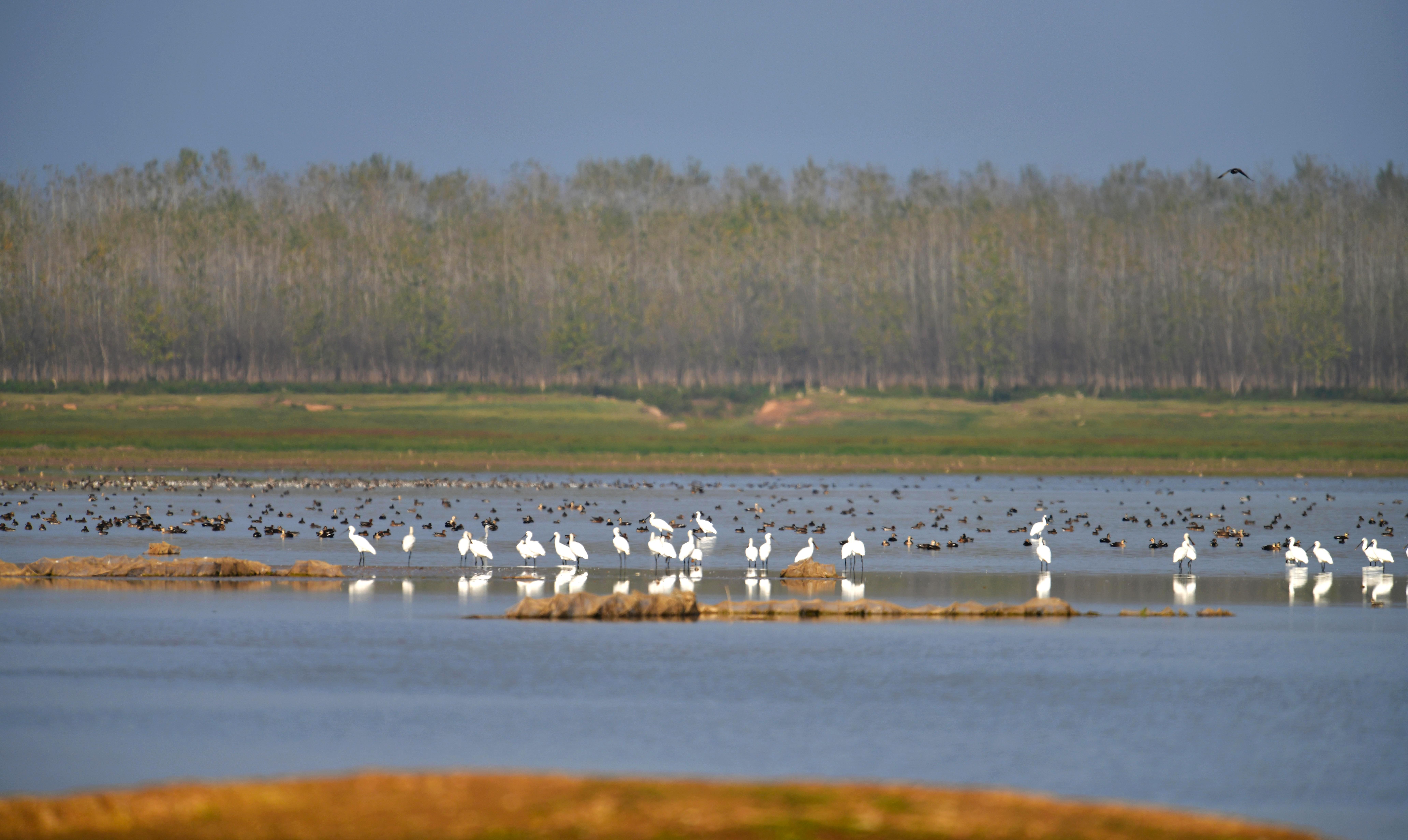
Photo taken on Dec. 3, 2019 shows migrant birds resting at Hengling Lake Provincial Nature Reserve, a part of Dongting Lake wetland, in Xiangyin County, central China's Hunan province. (Xinhua/Chen Zhenhai)
As the environment is improving, birds begin to regain their interest in China's second-largest freshwater lake.
CHANGSHA, Dec. 8 (Xinhua) -- Many years ago, when a swan flew over Dongting Lake, China's second-largest freshwater lake, it would be almost impossible for it to find a place to rest.
Mei Biqiu, a former conservation official, recalls when the lake's wetlands were lush with black poplars, planted for timber and papermaking, depriving migratory waterbirds of their winter habitats.
"They are like the water pumps of wetlands -- where they are planted, the soil dried up, the grass wilted and the birds left," said Mei, former chief of the administration of the West Dongting Lake Nature Reserve.
Apart from poplars, there were seven or eight papermaking factories that reaped reeds and over 30 sand boats and over 100,000 nets that made the lake perilous for birds and fish, the retired official said.
For thousands of years, the Dongting Lake along the Yangtze River, Asia's longest river, had been a thoroughfare for migratory birds with its biologically rich wetlands, a status tarnished amid the anti-hunger drive and economic pursuit in the last century.
It was not until recently that birds began to regain their interest in the lake.
In 2017, the lake launched a campaign to chop down invasive poplars. The West Dongting Lake Reserve alone has cleared over 6,600 hectares of poplars and plans to complete the eradication by 2020.
Meanwhile, the reserve has shut down all the paper mills and pig farms that discharge effluent into the lake and is gearing up for a 10-year fishing moratorium, which will be effective on Jan. 1, 2020, on the Yangtze River.
"Despite the old saying: 'Rely on the water for survival when there is water,' we've come to realize that a development model that depletes nature will not last long," he said.
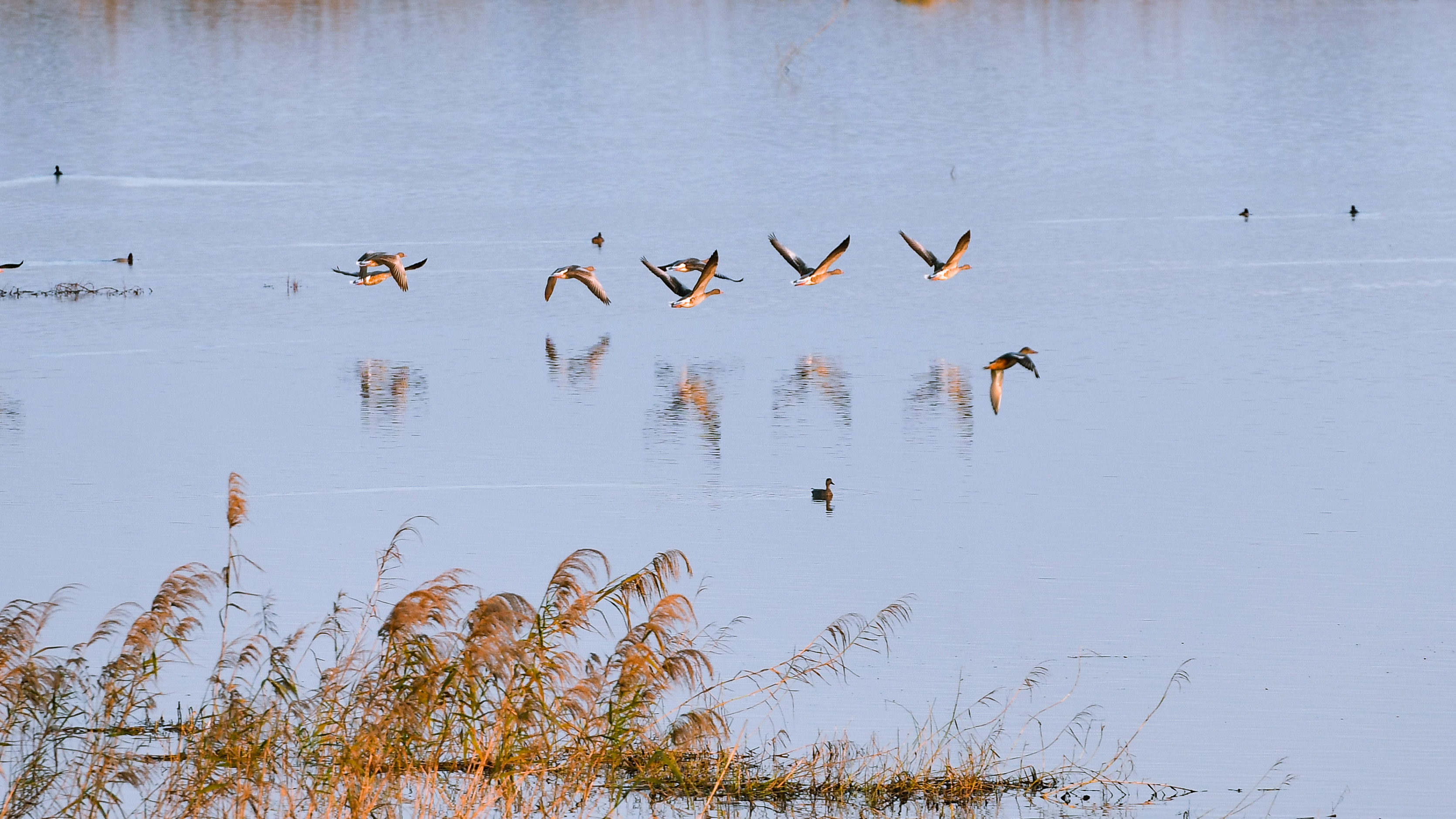
Photo taken on Dec. 2, 2019 shows migrant birds flying at Hengling Lake Provincial Nature Reserve, a part of Dongting Lake wetland, in Xiangyin County, central China's Hunan province. (Photo by Guo Yudi/Xinhua)
SURVIVAL ISSUES
Tang Daiqin, a fisherman in his 70s, recalled the locals' eventual withdrawal from Dongting Lake to rectify decades of abuse.
In the 1970s, when hunger and scarcity prompted China to prioritize food production, villagers inhabiting Dongting Lake zealously jumped into a dike-building drive to reclaim farmlands and fish ponds.
"Over 10,000 people gathered around the lake on the second day of the Lunar New Year of 1975, carrying sand on their shoulders and backs. Everyone worked from daybreak to late into the night to finish before the water level rose in July," he said.
While the massive reclamation driven by the survival urge resulted in the villagers' increased vulnerability in times of flood, several rounds of the profit-driven poplar planting craze since 1977 incurred greater ecological calamity.
Statistics show that as of 2016, the Dongting Lake area had been occupied by 26,000 hectares of black poplars. These tall, strong and fast-growing trees were blamed for killing the wetlands by hardening the soil and blocking sunlight for other plants.
In 1998, after a huge flood swept the Yangtze River, destroying houses and farms around the lake, the Chinese government decided to "return the land to the lake." Under the guidance of local governments, Tang and 5,800 other fishermen and farmers were resettled outside of the Qingshan Dyke that they had once built.
It was not a smooth transition. Many villagers who failed to find other means of livelihood returned to the lake and engaged in illegal fishing and bird hunting, often by electrocuting or poisoning the water. The establishment of the reserve in 1998, and its implementation of a fishing and hunting ban, also ran into strong local opposition.

Two migrant birds fly at the Hengling Lake Provincial Nature Reserve, part of the Dongting Lake wetland, in Xiangyin County, central China's Hunan Province, Dec. 2, 2019. (Photo by Guo Yudi/Xinhua)
RETURN OF BIRDS
The new century continued to witness constant conflicts between villagers and conservation officials and hard negotiations. "We eventually managed to find common ground. We fishermen didn't want the lake that our livelihoods rely on to be polluted either," Tang said.
Since 2004, the reserve has inked deals with the fishermen's cooperatives to allow eco-friendly aquaculture activities. Fishermen, on their part, agreed to refrain from using chemical fertilizers and illegal means like poisoning.
Since then, more fishermen and villagers have joined associations on environmental protection, said He Muying, conservation personnel with the reserve, adding that they also plan to promote bird watching and eco-tourism as new bread earners for local fishermen.
The lake now presents a picture of fast-recovering wetland ecology.
So far this winter, over 30,000 migratory birds have arrived at West Dongting Lake, including 78 black stocks under top-level state protection. The Hengling Lake Nature Reserve, on the southern bank of Dongting, has received 55,000 birds, already surpassing last winter's 40,000.
Zhang Xiaobo, a researcher with Beijing Forestry University that has been carrying out research in the reserve for years, praised the removal of poplars and fishing bans for improving the lake's biodiversity.
Monitoring over the years pointed to the accelerated growth of submerged plants such as eelgrass and an increasing number of birds from white cranes to little swans, Zhang said. "All these changes indicate that the ecology of West Dongting Lake is gradually recovering." ■
