



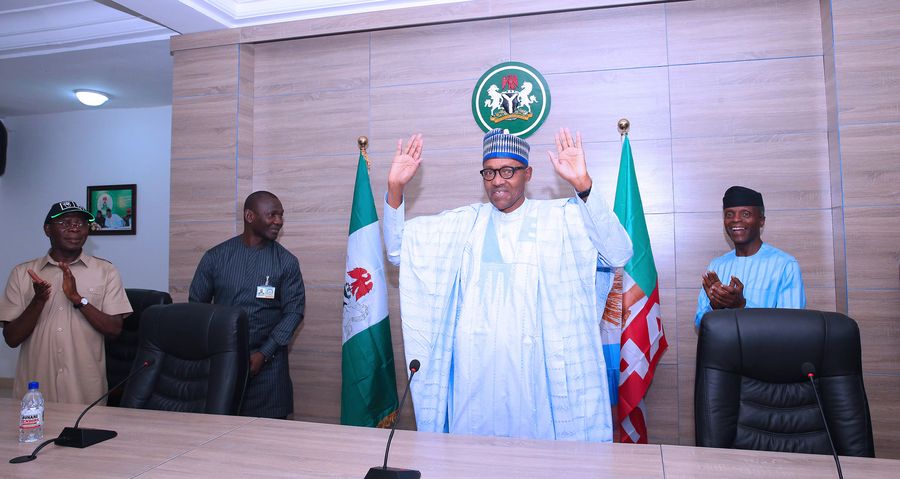
Nigerian President Muhammadu Buhari (Front) arrived at the office of the All Progressives Congress to celebrate his victory in presidential election in Abuja, Nigeria, on Feb. 27, 2019. (Xinhua/Olatunji Obasa)
The outgoing 2019 has been a year of difficulty and progress for Nigeria, Africa's most populous country. This year has seen a peaceful general election and recovering economic growth, however, insecurity still poses great challenges to development and the land border closure draws some criticism.
by Bosun Awoniyi
LAGOS, Dec. 28 (Xinhua) -- The outgoing 2019 has been a year of difficulty and progress for Nigeria, Africa's major oil exporter, and Nigerians across the world. There have been many moments, missteps and successes.
The year has been quite a significant year, which in many ways has reshaped the country for years to come.
At the start of the year, general polls were held on Feb. 23 to elect the president and members of the house of representatives and the senate.
The elections had initially been scheduled for Feb. 16, but the country's election body postponed the vote by a week on the original polling day, citing logistical challenges in getting electoral materials to polling stations on time.
However, the elections were the most peaceful ones since the violent insurgence of Boko Haram in 2009. The extremist group did not cause as many troubles during the elections as in 2015.
Incumbent President Muhammadu Buhari won his reelection bid, defeating his closest rival Atiku Abubakar by over 3 million votes.
He has identified fighting corruption, increasing security, tackling unemployment, diversifying the economy, enhancing climate resilience, and boosting the living standards of citizens as main policy priorities his government seeks to continue to pursue in his second term up till 2023.

File photo shows Nigeria's security officers were inspecting the scene of a suicide bomb attack in Maiduguri city, northeastern Nigeria, Oct. 2, 2015. (Xinhua/Olatunji Obasa)
INSECURITY PERSISTS
Nigeria had been confronted with a myriad of security challenges which include terrorism, kidnapping, militancy, small arms and light weapons proliferation, banditry, and pastoralists/farmers conflicts, among others.
In recent times, the west African nation witnessed an unprecedented level of insecurity. The major security crisis seizing Nigeria these days is kidnappings for ransom.
A year ago, the spotlight was on violent conflict between farmers and herders. Before that, it was Boko Haram. Even earlier, it was the tensions in the Niger Delta, and so on.
According to official statistics, from January to July in 2019, about 330 attacks were recorded, resulting in the death of about 1,460 civilians.
However, between June and July, the number of incidents declined, especially in northwest Zamfara State that had been the epicenter of armed banditry.
Government attributed the decline to the combination of both kinetic and non-kinetic measures put in place by the government.
Boko Haram has continued to attack remote communities and military locations, but hold no more strongholds within Nigeria's territory while operations against Boko Haram in the area turned its ninth year.
More than 10 civil and military targets have been attacked by Boko Haram militants in the last nine months, fueling concern among civilians that the crisis may prolong.
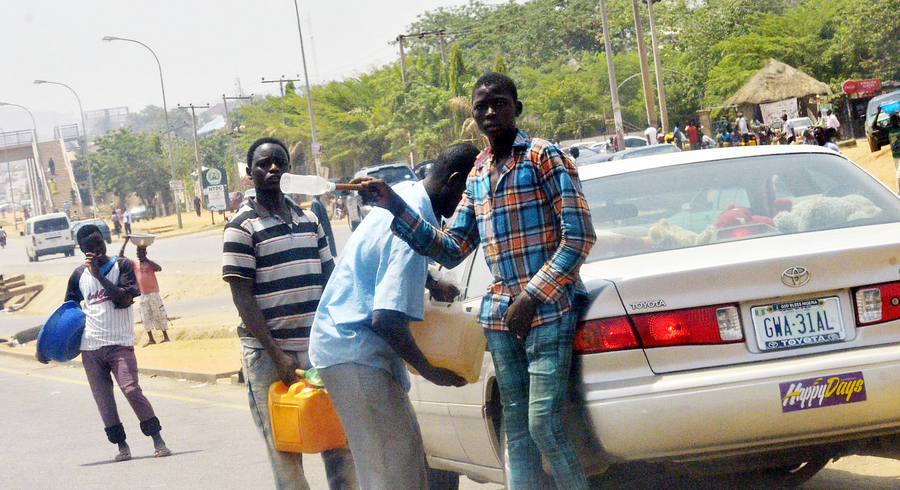
Hawkers were selling fuel on the streets of Abuja, capital of Nigeria. (Xinhua/Olatunji Obasa)
LAND BORDER CLOSURE
However, the government's land border closure in August proved to be the spanner in the works, as the impact of the policy on food prices sent inflation to an 18-months high in October -- a period that coincides with the main harvest season in Nigeria, which should ordinarily lead to an inflationary downtrend.
The operation under the code-name "Ex-Swift Response" was a collaborative security operation involving the Nigeria Immigration Service and Nigeria Customs Service together with Nigeria Police Force and the Armed Forces.
Nigerian President Buhari attributes the partial closure of border with the Benin Republic to the massive smuggling activities, especially of rice, taking place on that corridor.
He expressed great concern over the smuggling of rice, noting that it threatens the self-sufficiency already attained due to his administration's agricultural policies.
But critics insisted that border closure is an economic aberration as most countries don't usually close their borders for trade-related reasons.
According to them, the closure has the potential to disrupt the economic lifelines of many traders who depend on legitimate cross-border trade.
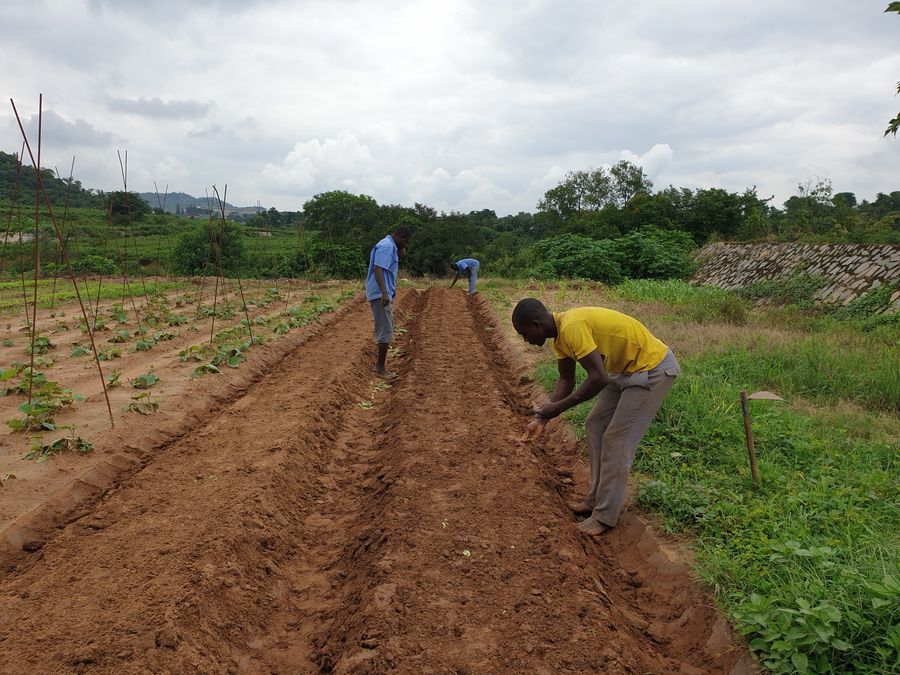
Farmers were going about their work at a high-tech agricultural industrial park in Abuja, Nigeria, Aug. 29, 2019. (Xinhua)
ECONOMIC DIVERSIFICATION
As the government is doing all it takes to diversify the economy, Nigeria's agricultural sector, a major employer across the country but being neglected for decades, began to see more support from the government.
Buhari recently banned the use of foreign exchange especially to food importers, an attempt to boost local agriculture across Nigeria and undeniably -- domestic rice production has increased since the policy became effective.
Generally, Nigeria recorded steady growth in its economy due to the political will of the Buhari administration, as the country has recorded some landmark strides on several fronts relating to the economy.
One of them is the 5.2 billion naira (about 14.4 million U.S. dollars) trading surplus recorded by the Nigerian National Petroleum Corporation (NNPC) for the month of August. The figure is a 22 percent increase on the 4.26 billion naira surplus posted in July and this, experts believe, is a clear indication that the national oil company can indeed operate profitably.
The value of Nigeria's total trade in third quarter of 2019 stood at 9,187.6 billion naira, representing a 6.77 percent increase over the value recorded in second quarter of 2019 and a 1.33 percent increase on third quarter of 2018.
Although there was a slight decline in import figure, the increase in export led to a positive trade balance of 1,389.3 billion naira during the period under review.
Also, the gross domestic product growth (GDP) has remained positive for 10 consecutive quarters after the recession, according to the Central Bank of Nigeria.
For the 2nd and 3rd Quarter of 2019, GDP growth stood at 2.1 percent and 2.28 percent respectively.
The apex bank said the positive growth in GDP has been driven by improvements in Agriculture, Oil and Gas, Manufacturing and Information Communication Technology.
Uche Olowu, the president of Chartered Institute of Bankers of Nigeria (CIBN), has urged the government to properly execute economic policies that would uplift the masses from poverty, adding Nigerians expect a renewal of things to happen in 2020.■
