



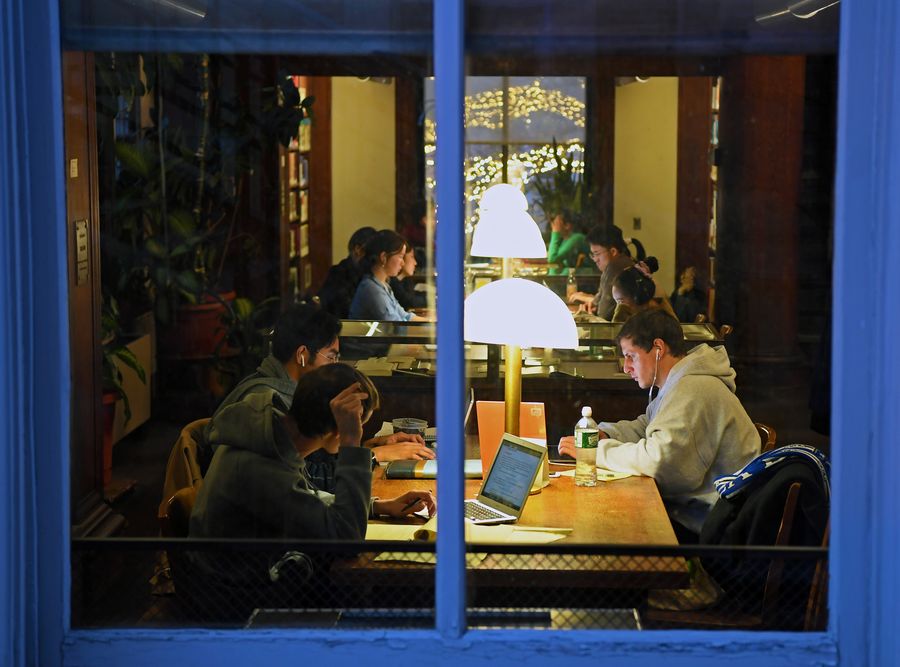
Students study at a library of Columbia University in New York, the United States, on Dec. 7, 2019. (Xinhua/Li Rui)
Over the past year, many Chinese students have put U.S. visa obstacles into perspective and moved on to other global destinations for higher education as well as institutions at home.
by Xinhua writers Xia Lin, Zhang Yichi
NEW YORK, Jan. 1 (Xinhua) -- An increasing number of Chinese students have put U.S. visa obstacles, along with social instability and climbing tuition fees, into perspective, and moved on to other global destinations for higher education as well as institutions at home, as industry professionals have observed while looking back at 2019.
"Chinese students' enthusiasm for American higher education has been dampened by the U.S. administration's visa policy, which has delayed or denied entries to many of them, especially those aiming for STEM (science, technology, engineering and mathematics) degrees," said Annabelle Ding, admission representative at Columbia University School of Professional Studies, in a recent interview with Xinhua.
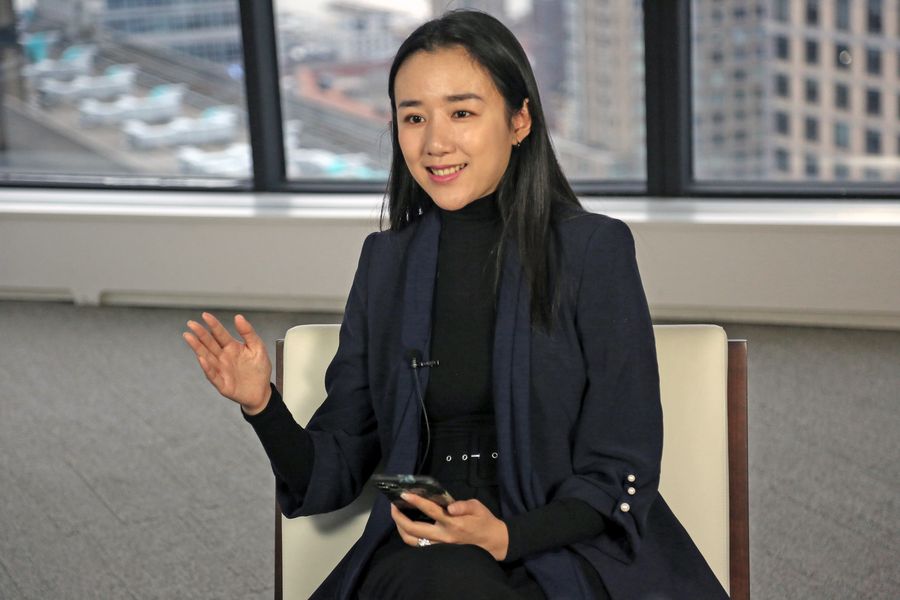
Annabelle Ding, admission representative at Columbia University School of Professional Studies, speaks in an interview with Xinhua in New York, the United States, on Dec. 6, 2019. (Xinhua/Li Rui)
According to the non-partisan think tank Migration Policy Institute (MPI), new international student enrollment at U.S. colleges and universities dropped for the third year in a row, and the number of student visas issued to Chinese applicants went down by 54 percent in fiscal year 2018 from fiscal year 2015. Not incidentally, the United States reportedly saw an increase of only 1.7 percent for Chinese students in fall 2018, the lowest in a decade.
"Recent U.S. policies have affected its image and reputation, obstructed its exchange with other countries, and undermined its own interests," Chinese Foreign Ministry spokesman Geng Shuang told reporters in November.
"Today, it is all the more important for us to create positive conditions for exchange of students as well as people-to-people ties with an open and inclusive attitude," Geng said.
VOICES AGAINST VISA POLICY
Lindsay Zou founded offerbang.io to provide career education for international students and professionals, after dabbling in Wall Street as a financial executive upon completion of her schooling years in New York and Beijing.
"I've met Chinese students hurt by visa delay or denial. As a consequence, the upcoming ones are overshadowed. Seeing the hardship of studying and job finding in the United States, they'd rather stay in China for higher education, relinquishing their overseas plans at all," she said.
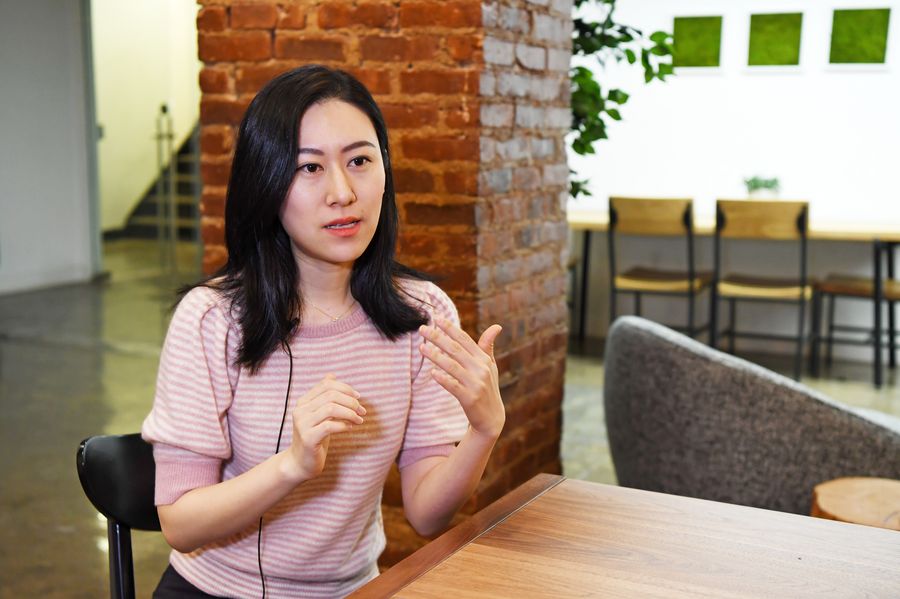
Founder of offerbang.io Lindsay Zou speaks in an interview with Xinhua in New York, the United States, on Dec. 11, 2019. (Xinhua/Li Rui)
Lan Yang just obtained his master's degree of computer science at Pace University this year and found a job as a product and user interface/user experience manager at Zou's company. Some of his Chinese friends and classmates were not as lucky as him.
"As I know, you have to wait longer to get your student visa, which worries not only the students themselves but their parents. For those who are still planning their studying trips to the United States, it is an omen clearly spelt - they react in no other way but jump to a conclusion that America is unfriendly toward Chinese students," he said.
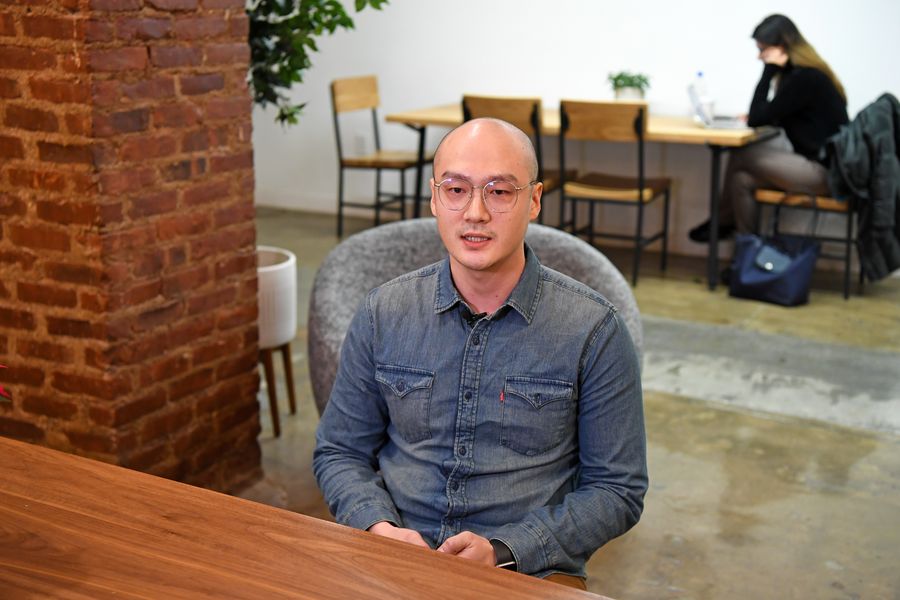
Product and user interface/user experience manager of offerbang.io Lan Yang speaks in an interview with Xinhua in New York, the United States, on Dec. 11, 2019. (Xinhua/Li Rui)
Rachel Banks, director of public policy at NAFSA: Association of International Educators, was recently quoted by The China Press as saying that the U.S. administration's visa policy and its leaders' comments were the prime factor that stemmed the influx of international students.
U.S. President Donald Trump and White House officials have denied such accusations.
Caroline Casagrande, deputy assistant secretary for academic programs in the U.S. Department of State's Bureau of Educational and Cultural Affairs, told Xinhua at the end of November that "our visa policy is matching our discussion, which is coming from the highest office in the land. The president recently said out of the Oval Office (that) we welcome Chinese students into our universities."
What Casagrande referred to was Trump's remarks made on Oct. 11 in the White House -- "Our universities are available. The world comes in. They use our universities. We have the greatest system in the world. And China is not going to be treated any differently."
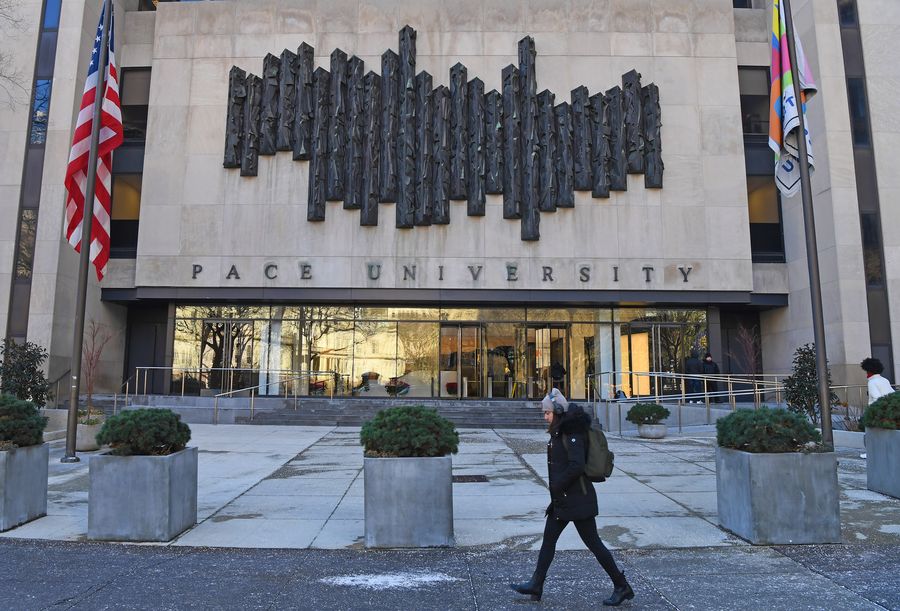
A student walks past a building of Pace University in New York, the United States, on Dec. 19, 2019. (Xinhua/Li Rui)
However, U.S. universities and education organizations picked up a different tone.
"We want the pathway (of coming to the United States) to be very clear and very transparent and very predictable. And what we're hearing from Chinese students is that's not always the case," Brad Farnsworth, vice president of American Council on Education, told Xinhua recently.
Months earlier, top universities like Massachusetts Institute of Technology, Yale University, Harvard University and University of California Berkeley voiced their concern that their government's visa policy created "toxic atmosphere" and ran counter to their doctrine of openness and transparency. Chinese students were always welcomed by U.S. universities, they added.
For the 10th consecutive year, China remained the largest source of international students in the United States in 2018/19, with 369,548 students in undergraduate, graduate, non-degree, and OPT programs.
International students, making up 5.5 percent of the total U.S. higher education population, contributed 44.7 billion U.S. dollars to the country's economy in 2018, an increase of 5.5 percent from the previous year, according to the latest data from the U.S. Department of Commerce.
Meanwhile, according to NAFSA's recent statistics, the consecutive slump of new international students since 2016 has led to a loss of 11.8 billion dollars to the U.S. economy.
"To be frank, it is no more the choice of choices, but one choice of choices for Chinese students to get enrolled at an American university. I recommend that they make dual options for higher education: maybe one is coming to the United States and the other is to other nations, including China itself," said Ding.
Canada, Australia and China have been catching up in attracting international students, said a report issued in December by the Center for China and Globalization (CCG) at a summit on the internationalization of higher education in Beijing.
According to the report, China now accounts for 10 percent of the world's total international students, ranking No. 3 on the global charts in this category, and plans to host 500,000 international students at all academic levels by 2020. ■
