



After its more-storied cousin, the Baiji dolphin, was declared "functionally extinct" in 2007 in the same waters, the finless porpoise is thus believed by experts to be the Yangtze's last surviving mammal.
To protect the animal, authorities across China have taken concerted efforts carrying out a series of measures, including preventing water pollution, restricting ship movement and patrolling the nature reserves every day.
by Xinhua writers He Leijing, Chu Yi
NANJING, Jan. 4 (Xinhua) -- Somewhere along the lower reaches of China's Yangtze River, a slick black back briefly arches above the silvery surface as one of the world's most endangered animals emerges, gulping for some air.
Such a glimpse of the Yangtze finless porpoise is taken by many Chinese as a good omen since the fleshy aquatic animal is critically endangered, rarer even than the country's poster child for species conservation, the giant panda.
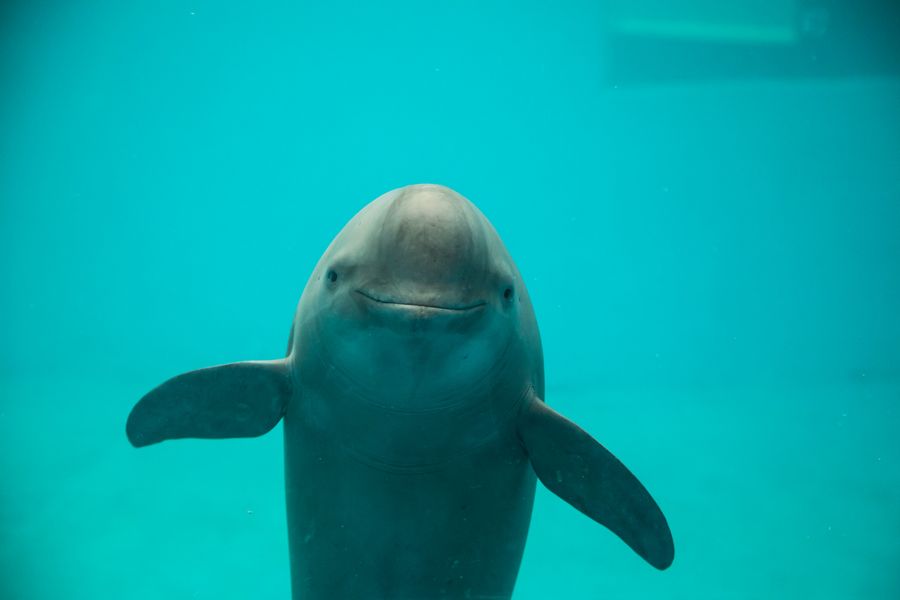
Undated file photo provided by the Nanjing Yangtze Finless Porpoise Conservation Association shows a Yangtze finless porpoise in the water. (Zhang Kun/Nanjing Yangtze Finless Porpoise Conservation Association/Handout via Xinhua)
The latest research on the species released by the Ministry of Agricultural and Rural Affairs in 2018 showed that there was a wild population of just 1,012 still navigating the twists and turns of the longest river in Asia.
After its more-storied cousin, the Baiji dolphin, was declared "functionally extinct" in 2007 in the same waters, the finless porpoise is thus believed to be the Yangtze's last surviving mammal, said Jiang Meng, secretary-general of the Nanjing Yangtze Finless Porpoise Conservation Association.
"SMILING ANGEL" IN DANGER
The freshwater porpoise with no dorsal fin is native to China. They only pulse through the waters in the central and eastern parts of the Yangtze including two lakes naturally connected to the 6,300-km river, Dongting and Poyang, according to conservationists.
With its mouth fixed in a permanent grin, the rotund finless porpoise is adored in China as a "smiling angel." But this "angel" that has lived in the waters for some 25 million years is fighting for its very survival.
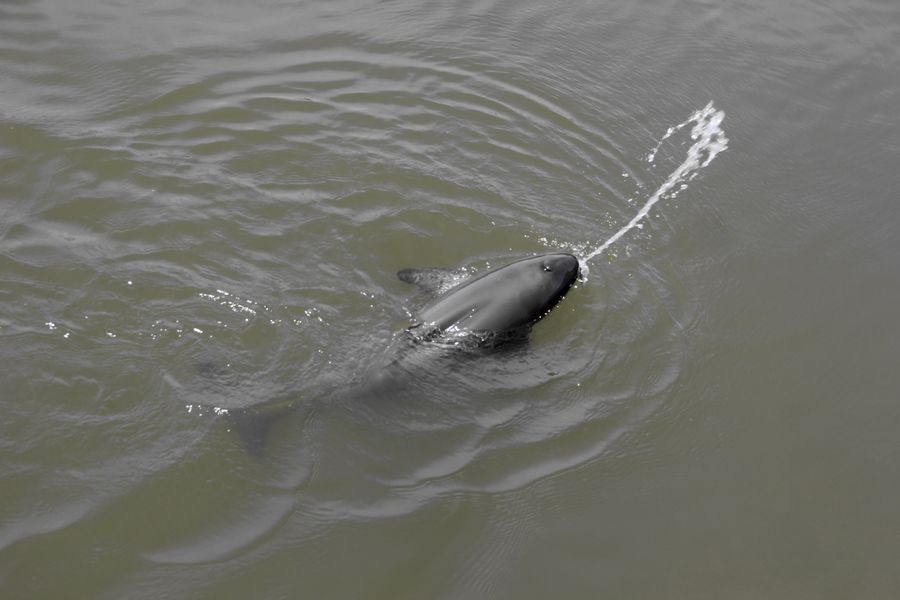
File photo taken on Sept. 2, 2019 shows a Yangtze finless porpoise in the Yangtze River in Nanjing, capital of east China's Jiangsu Province. (Nanjing Yangtze Finless Porpoise Conservation Association/Handout via Xinhua)
The riverbank of the Yangtze used to be studded with steel mills and petrochemical companies that took advantage of cheap water transport, causing water quality to deteriorate.
"Unsustainable fishing which reduced its natural prey, collisions with shipping traffic and water pollution have all impacted the porpoise's health and rendered it to be critically endangered," Jiang said.
The extinction of the Baiji stung the collective conscience of the Chinese people. "We cannot afford to let the 'smiling angel' go extinct," he added. "Its fate foreshadows the health of the whole river ecosystem. So the crisis is also our own."
The finless porpoise requires healthy river ecosystems, and so do the millions of people who live in the Yangtze River basin. Protecting the creature will also help alleviate China's food and water security issues, said Karin Krchnak, director of the World Wildlife Fund's freshwater program.
"Fortunately, people have awakened and are racing to save them," Jiang said.
CONCERTED EFFORTS
Nanjing, capital of east China's Jiangsu Province, is the only Chinese city where visitors can observe the river rarity in an urban area. More than 50 finless porpoises have been spotted in the Yangtze River section in Nanjing.
In 2014, the local government opened a provincial protection zone that covers a total area of nearly 87 square km along the Yangtze for the endangered species.
Earlier this year, Nanjing has made several design adjustments in building a new trans-Yangtze traffic passage, to minimize the impact on the endangered animal.
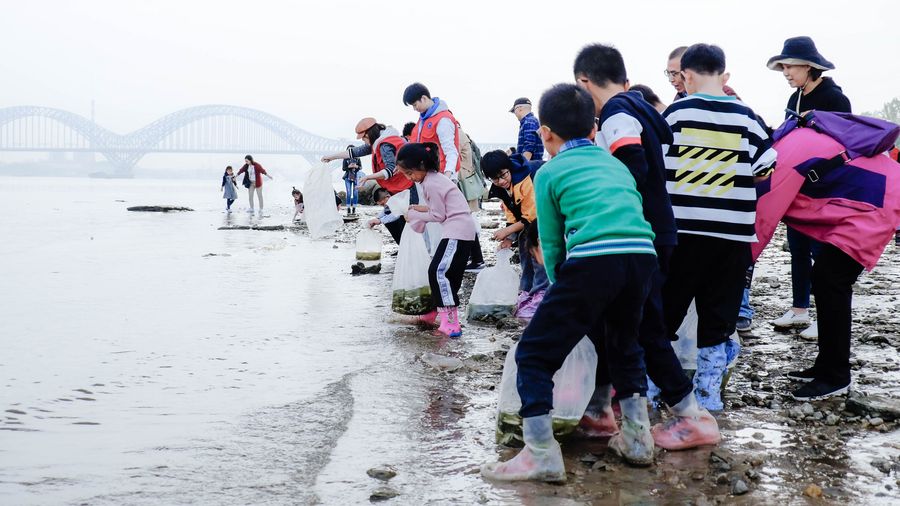
Citizens release fry voluntarily into the Yangtze River in Nanjing, capital of east China's Jiangsu Province, Nov. 15, 2019. (Nanjing Yangtze Finless Porpoise Conservation Association/Handout via Xinhua)
Eagles and migratory birds can always be seen flitting around the 30-square-km core part of the zone, where the construction of any production facilities is strictly prohibited, according to the environmental protection bureau in Nanjing.
"It pays to do so," Jiang said. He set up the conversation association in 2015 in the hope of educating local people to care for the finless porpoise and has organized over 100 public engagement activities in local schools and communities.
The quality of the porpoise's habitat is a benchmark for its protection, said Sun Lifeng, an official with the Nanjing Dolphin Nature Reserve. "We have been devoted to the afforestation of the Yangtze River shoreline as wetlands are critical for the entire ecological environment."
Since 2016, the environmental protection of the Yangtze, rather than large-scale development, has become the dominant focus of the country's river development plans.
The rallying call was heard as authorities across China carried out a series of measures, including preventing water pollution, restricting ship movement and patrolling the nature reserves every day.
Jiangsu Province, in the lower reaches of the Yangtze, closed more than 6,000 chemical firms near the river in the last three years. And Chongqing, lying upstream, aims to remove all companies which have dilapidated equipment from the river by 2020.
"Official clampdowns on overfishing and polluting activities have gradually restored the water quality of the Yangtze," Jiang said.
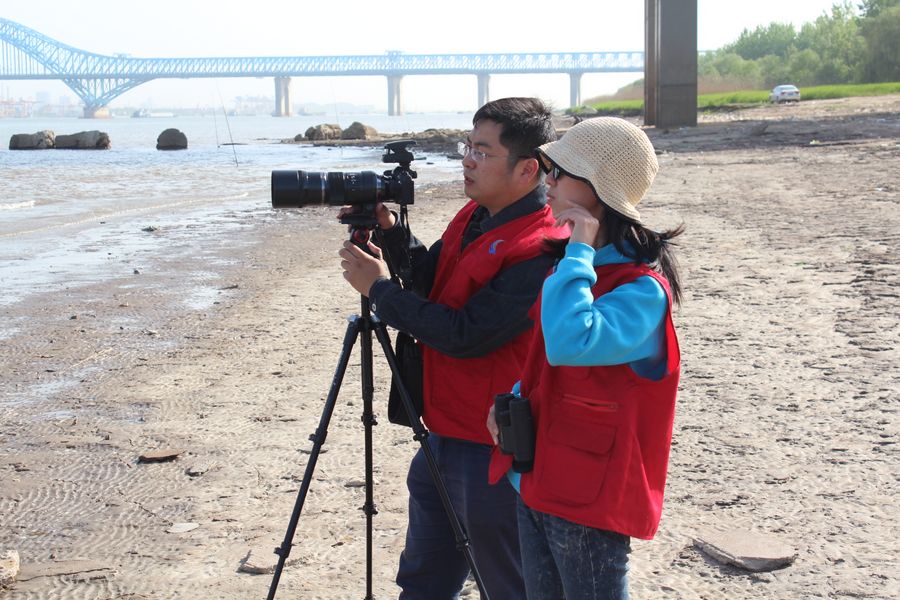
File photo taken on April 9, 2018 shows Jiang Meng (L), secretary-general of the Nanjing Yangtze Finless Porpoise Conservation Association, observing Yangtze finless porpoises by the Yangtze River in Nanjing, capital of east China's Jiangsu Province. (Nanjing Yangtze Finless Porpoise Conservation Association/Handout via Xinhua)
ENCOURAGING SIGNS
The latest research in 2018 showed China had 1,012 finless porpoise, a slight drop from 1,040 in 2012, which suggests all the conservation efforts may be making a dent, said Wang Ding, a researcher with the Chinese Academy of Sciences.
The protection work has shown encouraging signs. Chinese lawmakers started deliberating the country's first legislation on a specific river basin, a draft law on Yangtze River conservation aimed at protecting the ecological environment and facilitating green development.
The Chinese government is also pushing for a 10-year fishing ban from 2020 in the Yangtze, which is to be observed in 332 conservation areas along the waterway, before expanding to the entire river and its main tributaries next year.
Yang Jinlong was once a fisherman in Nanjing. The 45-year-old chose to be a patrolman in an all-volunteer monitoring team consisting of dozens of fish farmers in 2016, when the city closed a large number of fishing-related enterprises along the Yangtze.
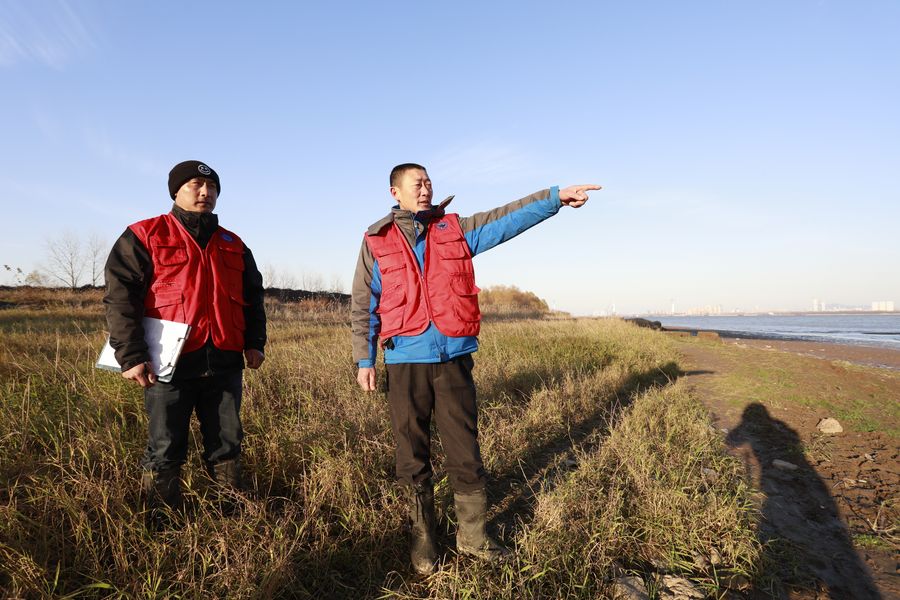
File photo taken on Dec. 28, 2018 shows former fisherman Yang Jinlong (L), a patrolman in an all-volunteer monitoring team consisting of dozens of fish farmers, monitoring the protection of Yangtze finless porpoises with a volunteer by the Yangtze River in Nanjing, capital of east China's Jiangsu Province. (Nanjing Yangtze Finless Porpoise Conservation Association/Handout via Xinhua)
Yang gradually came to understand the finless porpoises after years of hard work recording their tracks at the monitoring sites in the protection zone.
"I grew up near the Yangtze and it brings me peace of mind," Yang said. "It doesn't matter that we can't fish, but it matters that the 'smiling angel' keeps smiling."
In recent years, the monitoring team has captured countless precious pictures and footage of the porpoises, providing support for scientific research of the at-risk animal.

File photo taken on Dec. 23, 2018 shows volunteers introducing the Yangtze finless porpoise to the public in Nanjing, capital of east China's Jiangsu Province. (Nanjing Yangtze Finless Porpoise Conservation Association/Handout via Xinhua)
With increasing environmental awareness, more Chinese people are willing to volunteer to protect the porpoise, Yang said. "When I see the animal jumping out of the water, I feel fulfilled. It's like everything we've done is worth it."
"And we see changes," he added. "Little young finless porpoises can often be spotted now, which indicates the endangered mammal is thriving."
(Xinhua correspondents Qin Huajiang, Zhen Shengzhu also contributed to the story.)
(Video reporter: Liu Yuxuan; Video editor: Peng Ying)■
