NEW DELHI, April 11 (Xinhua) -- The Belt and Road Initiative (BRI) could be regarded as an antidote to anti-globalization and protectionism given its emphasis on peace and cooperation as well as openness and inclusion among its partner nations, says one scholar.
Developing countries would benefit greatly from the initiative, which is focused on connectivity, developing new markets and green development, B.R. Deepak, professor of Chinese Studies in India's Jawaharlal University, New Delhi, told Xinhua in an interview on Tuesday.
The Belt and Road Initiative proposed by China in 2013 aims to build trade and infrastructure networks connecting Asia with Europe and Africa along and beyond the ancient Silk Road trade routes.
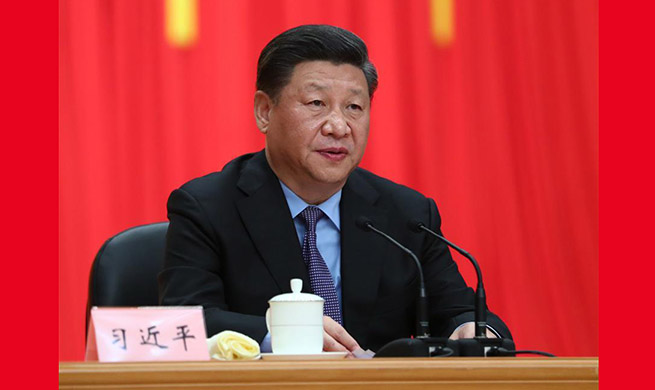
"One must understand that the Belt and Road (Initiative) is fundamental to the global industrial chain and those who join it will reap the benefits," Deepak said in response to a keynote speech made by Chinese President Xi Jinping at the opening ceremony of the Boao Forum for Asia annual conference.
"It must be pointed out that as the BRI is a new initiative, it is perfectly natural for there to be different views in cooperation. As long as the parties embrace the principle of extensive consultation, joint contribution and shared benefits, we can surely enhance cooperation and resolve differences," Xi said.
"This way, we can make the BRI the broadest platform for international cooperation in keeping with the trend of economic globalization and to the greater benefit of all our peoples," Xi said.
Moreover, the initiative will not only benefit Asian countries, but also the entire world, Deepak said. "It remains indispensable to the globalization and deepening of the reforms in China."
Xi's advocacy of building a community with a shared future for mankind, the Chinese Dream, the Belt and Road Initiative, etc. should not be merely seen as Chinese initiatives, for they are integral to regional as well as global economic development, the Indian scholar said.
"These are synonymous to the circulatory movements of ideas, technology, commodities and people along the ancient Silk Road that enriched Asian and world civilizations," he said, adding that they could be treated as "multidirectional, multimodal and multilateral flows where there is so much to gain but nothing to lose."
Citing UN poverty alleviation goals and hailing China's work in this regard as "a huge contribution to mankind," Deepak said in the past 40 years China has lifted 700 million people out of poverty, amounting to almost 70 percent of the world's poverty alleviation efforts.
Developing countries can learn from the Chinese experience of abolishing illiteracy, generating employment opportunities, improving health and hygiene, supplying goods and services to the rural masses, increasing income levels and tackling issues related to the environment and governance, Deepak said.
Poverty remains deeply entrenched in Asian countries especially in South Asia.
According to a World Bank Report, of the 766 million extremely poor who live below the poverty line of 1.9 U.S. dollars a day in 2016, about 33 percent live in South Asia and 9 percent live in East Asia and the Pacific. The issues related to poverty are illiteracy, unsafe drinking water, open defecation, urban slums and bad governance.
Deepak said the Chinese experience would come in handy, including China's efforts to raise peasant incomes, and providing them with public goods, health and education, especially vocational education.
Linking poverty reduction programs with efforts to expand infrastructure, industry, agricultural output and social development in China could be replicated by other Asian nations because the problems of developing countries with large populations are akin to those China dealt with, Deepak said, adding solutions are not to be found in the Western experience.