QINGDAO, Nov. 28 (Xinhua) -- China-developed "magic soil," a kind of modified clay, has become a hero in extinguishing red tide, a harmful algae bloom that causes damages to the marine aquaculture in the U.S. and Chile.
Last week, 300 kg of the material was delivered from the port city of Qingdao in east China's Shandong Province to Florida, where an abundance of offshore red tide since summer has threatened tourism and human health.
The supply was part of an agreement reached between the Woods Hole Oceanographic Institution of America and the Institute of Oceanology of the Chinese Academy of Science (CAS), developer of the technology, in October to bring in 600 kg of the material for treating red tide bloom in Florida.
"The U.S. is very cautious about bringing in environmental protection technology. The export of our modified clay proves that China's technology on controlling red tide is leading the world," said Yu Zhiming, the chief scientist of the development program in the CAS institute.
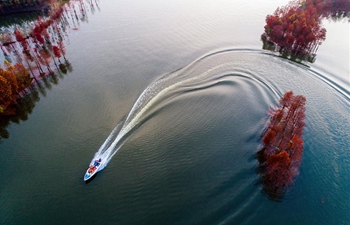
He explained that the modified clays are sprayed onto the red tide using a special apparatus aboard vessels. The material can take the majority of algae down to the seabed through flocculation and inhibit the growth of residual algae.
Yu's team has developed and upgraded the technology application since 1993. The synthetic material was first applied in Xuanwu Lake in Nanjing, capital of east China's Jiangsu Province in 2005, to mitigate harmful algae bloom.
In August 2008, a massive red tide hit 86 km of seashore near the Olympic Sailing Center of Qingdao, threatening the sailing events of the Beijing Olympic Games.
About 320 tonnes of the modified clay was continuously dispersed into the water within 30 hours, and the water quality was restored the day after. The threat to the sailing events was gone.
In 2014, the technology was included as a standard method in the "Technical Guidelines for the Treatment of Red Tide Disaster" in China. Currently, it is the only large-scale field application method available to mitigate algae bloom in China.
The material made its first overseas exposure last year when 27 tonnes of the material was used in Chile to salvage salmon farming from algae bloom.
The red tide caused economic losses of 1 billion U.S. dollars to Chile's aquaculture industry between the end of 2015 and early 2016.
As the main source of salmon and trout in the world, Chile's aquaculture industry provides income for thousands of families.
The Chilean government sought solutions worldwide for treating the red tide disaster.
Yu's team received a Chilean delegation with members from the government and aquaculture experts in October 2016.
"The delegation signed the contract shortly after visiting our manufacturing sites and witnessing dispersal demonstrations," said Yu.
"As agreed, we jointly developed specially modified clay in full consideration of its application in Chile and tested its effects on salmon and shellfish many times. It turns out that the newly modified clays do not harm the cultured species," said Yu.
After third-party testing by the Woods Hole Oceanographic Institution in the United States, the modified clay was shipped from China in December 2017.
Yu said by changing the surface charges of clay particles from negative to positive, the modification can increase attractive interaction between clay particles and algae cells, incurring flocculation, which can be enhanced through inserted modifiers such as poly-aluminum compounds and aluminum sulfate.
"It needs 4-10 grams of modified clay to eliminate algae per square meter, which doesn't harm the ocean," said Yuan Yongquan, a member of Yu's team.
Laboratory investigations revealed that the reaction between modified clays and algae can generate a large number of reactive oxygen species (ROS), which are widely used in sterilization, also effective in curbing algae growth and proliferation.
Production of modified clays has been industrialized in China, and raw materials of the modified clays are common, like those used for producing ceramic or for construction.
The spraying equipment was developed to mix modified clays with seawater before spraying it from a high-pressure water gun. "The operation looks like an extinguisher for putting out fires," Yu said.